
 |
 |
 |
 |
 |
 |
 |
 |
 |

 |
Phoenix Completes Longest Work Shift
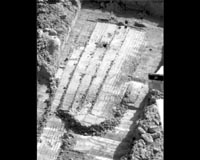
Tucson AZ (SPX) Jul 24, 2008 Phoenix early Tuesday finished its longest work shift of the mission. The lander stayed awake for 33 hours, completing tasks that included rasping and scraping by the robotic arm, in addition to atmosphere observations in coordination with simultaneous observations by NASA's Mars Reconnaissance Orbiter. "Our rasping test yesterday gave us enough confidence that we're now planning for the next use of the rasp to be for acquiring a sample to be delivered to TEGA," said Phoenix project manager Barry Goldstein of NASA's Jet Propulsion Laboratory, Pasadena, Calif. TEGA is Phoenix's Thermal and Evolved-Gas Analyzer, an instrument that heats samples in small ovens and uses a mass spectrometer to study the vapors driven off by the heating. As preparation for that sample delivery in coming days, the Phoenix team developed plans to command the lander Tuesday evening to conduct 80 scrapings of the bottom of a trench informally named "Snow White." The scraping is designed to freshly expose frozen material and ready the surface for using the rasp. The Phoenix mission is led by Peter Smith of the University of Arizona with project management at JPL and development partnership at Lockheed Martin, Denver. International contributions come from the Canadian Space Agency; the University of Neuchatel; the universities of Copenhagen and Aarhus, Denmark; Max Planck Institute, Germany; and the Finnish Meteorological Institute. Community Email This Article Comment On This Article Share This Article With Planet Earth
Related Links Mars News and Information at MarsDaily.com Lunar Dreams and more
 NASA's Phoenix Mars Lander Works Through the Night
 Tucson AZ (SPX) Jul 22, 2008
To coordinate with observations made by an orbiter flying repeatedly overhead, NASA's Phoenix Mars Lander is working a schedule Monday that includes staying awake all night for the first time. |
|
|

| The content herein, unless otherwise known to be public domain, are Copyright 1995-2007 - SpaceDaily.AFP and UPI Wire Stories are copyright Agence France-Presse and United Press International. ESA Portal Reports are copyright European Space Agency. All NASA sourced material is public domain. Additional copyrights may apply in whole or part to other bona fide parties. Advertising does not imply endorsement,agreement or approval of any opinions, statements or information provided by SpaceDaily on any Web page published or hosted by SpaceDaily. Privacy Statement |
 del.icio.us
 Digg
Digg Reddit
 YahooMyWeb
 Google
 Facebook