|
 |
 |
 |
 |
 |
 |
 |
 |

 |
Pescarolo Team Makes Fastest Lap At Le Mans
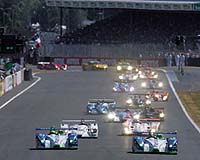
Le Mans, France (ESA) Jun 23, 2005 Congratulations to the drivers of the Pescarolo Judd racing car no. 16 for making the fastest lap at this year's Le Mans 24-hour race with a lap time of 3 min 35 s. Space technology also played its part, as it helped to make the car faster and safer. "This year our car is faster with a top speed of around 335 km/h and an average of 228.6 km/h around the 13.65 km track, " said Henri Pescarolo, manager of Pescarolo Sport motor racing team. ESA's Technology Transfer Programme (TTP) started working with Henri Pescarolo and Andre de Cortanze, Technical Director of Pescarolo Sport team, in 2002 on two priority lines: performance and security. In collaboration with Bertin Technologies in France this collaboration led to identifying areas that could greatly benefit from space technology: ultra-light very strong composite materials developed for satellite structures and thermal insulation materials used for the Ariane launcher. "Without ESA and the TTP we would not have known what is available and what can be adapted for our use. We now use high-stress composites designed for space to reduce the car's weight and protect against heat," said Andre de Cortanze. "We started cooperating with Pescarolo to test and validate our technologies for cars," said Pierre Brisson, Head of ESA's Technology Transfer and Promotion Office. "Our technologies are the result of years of research in Europe and have produced innovative solutions and remarkable results in space. Although developed for space programmes, in many cases space technology has provided intelligent and profitable solutions to problems on Earth. "There is a big potential for the use of space technologies on Earth but first we must demonstrate their worth in non-space fields by putting them under stress in tough situations. The 24-hours Le Mans endurance race is a great testing ground."
The race Right from the beginning of the legendary 24-hours Le Mans 2005 race it became clear that the two Pescarolo Sport's prototype cars were the fastest entries. When the race got under way at 16:00 on Saturday the two Pescarolo cars, powered with British Judd racing engines, immediately took the lead from the rest of the field and after the first hour had over a minute's lead. Car no. 16, driven by Emmanuel Collard, Jean-Christophe Boullion and Erik Comas, together with its sister car no. 17, driven by Sebastien Loeb, Eric Helary and Soheil Ayari, set a lap pace that was five seconds or more quicker than anyone else. No. 16 took the lead for the first two hours but then problems with overheating and the gearbox led to it dropping to 14th place after three hours. It then fell to 15th place until five hours into the race when the team's luck changed. The car's speed allowed them to overtake other drivers and by 04:00 on Sunday morning they were in third place with two Audis in front. By 07:00 the car was in second position, just three laps behind the leading Audi. The car's extra speed should have been enough to put it back on top but that is rarely how Le Mans works. As the race ended it was still in second position and two laps down due to overheating problems. Car no. 17 battled with continuous mechanical problems after its speedy start and was then hit by another car on a corner on the 188th. Because of the damage Henri Pescarolo had no choice but to withdraw the car from the race 19 hours into the race.
Space technology on board The cars' engines are insulated by a plate of carbon-fibre and aluminium, thus reducing the heat diffusion towards the petrol tank and the driver's cockpit. In addition, a micro-porous quartz ceramic material is installed around the exhaust system to reduce fire hazards. Both materials were originally developed for the Ariane launcher by the Belgium company Interthonica. Over the past three years the weight of the body has been continuously reduced improving the overall driving performance. For Le Mans 2003 the use of light space composite materials cut 29 kg off the weight and then further redesign in 2004 increased the saving to 38 kg. This year a new car was built to fit the new Le Mans Endurance Series (LMES) regulations. Once again the car profited from ultra-light but very strong space composite materials and another 15 kg was shaved off the weight, an important factor in its speed. A further improvement was reducing the friction and weight of the wheels by using special composite bearings developed by SNK, France, for space systems. Today these bearings are used in gyroscopes onboard satellites and in the fuel pump for the Ariane 5 Vulcain engine. "Once our technologies have proven their worth under extreme stress at extreme races, they will eventually find their way into the mass-produced cars we all use everyday, enhancing reliability and comfort, and contributing to greater overall safety on our roads," adds Pierre Brisson. "Remember that disk-brakes were first tested and proven by Jaguar at Le Mans in 1953; now they are standard on all cars." Community Email This Article Comment On This Article Related Links Le Mans official site Pescarolo Sport SpaceDaily Search SpaceDaily Subscribe To SpaceDaily Express Space Technology News - Applications and Research
 Industry Team Achieve New Communications Technology With AESA Radars
 Baltimore MD (SPX) Jan 12, 2006
A team comprised of three leading US aerospace and defense contractors has demonstrated an innovative technological use of active electronically scanned array (AESA) radars for high-bandwidth communications. |
|
|

| The content herein, unless otherwise known to be public domain, are Copyright 1995-2006 - SpaceDaily.AFP and UPI Wire Stories are copyright Agence France-Presse and United Press International. ESA PortalReports are copyright European Space Agency. All NASA sourced material is public domain. Additionalcopyrights may apply in whole or part to other bona fide parties. Advertising does not imply endorsement,agreement or approval of any opinions, statements or information provided by SpaceDaily on any Web page published or hosted by SpaceDaily. Privacy Statement |