|
 |
 |
 |
 |
 |
 |
 |
 |

 |
Permafrost Warming A Challenge To Tibetian Train Route
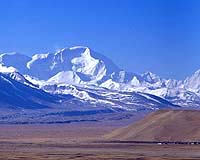
Boulder CO (SPX) Dec 14, 2004 Engineers constructing a new railroad across the vast, high-altitude Tibetan Plateau are using a surprisingly simple idea to fortify shifting frozen soils affected by climate warming, according to a University of Colorado at Boulder permafrost expert. "The Qinghai-Xizang railroad is the most ambitious construction project in a permafrost region since the Trans-Alaska Pipeline," said CU-Boulder and National Snow and Ice Data Center researcher Tingjun Zhang. Zhang is working closely on the project with scientists at the Cold and Arid Regions Environmental and Engineering Research Institute in Lanzhou, China. "This is the first time engineers are primarily using crushed rock to insulate and fortify a structure against permafrost," he said. Zhang will discuss the railroad project and the effects of widespread warming and thawing of frozen soils across the northern hemisphere at a press briefing in San Francisco Dec. 13 as part of the American Geophysical Union's annual meeting. He will lead a panel of permafrost and climate experts from universities in the United States, Canada and the United Kingdom. "If current observations are indicative of long-term trends, we can anticipate major changes in permafrost conditions during the next century," Zhang said. "Permafrost is thawing in many regions, and it is significantly influencing landscapes and ecosystems." One example is the Tibetan plateau, where the 695-mile Qinghai-Xizang railroad is due to be completed in 2007. More than 600 miles of track will be at altitudes of at least 13,000 feet above sea level, and 340 miles of track will lie across permafrost. Half of the permafrost area the tracks will cross is categorized as "high- temperature permafrost," Zhang said, meaning that the frozen soil is only 1 or 2 degrees Celsius below freezing. "The permafrost presents a challenge, because the climate of the area is predicted to become warmer during the next 50 to 100 years, and construction and train activity on the surface can also create heat and cause melting," Zhang said. "The shifting soils can ruin railroad tracks, roads and buildings. "In order to keep the track straight and the railroad foundation stable, engineers are using crushed rock to both insulate and cool the permafrost," he said. Using on-site experiments and mathematical heat transfer modeling, engineers determined that a 2- to 3-foot layer of loose, medium sized rocks minimizes heat intake to the soil under railroad embankments during warmer months and promotes heat loss in winter. "The rock layer is so effective that it actually helps create a net cooling effect over time," Zhang said. One experiment detailed in Zhang's presentation for the AGU meeting showed the permafrost under a railroad embankment was actually colder after a year of crushed rock insulation. Though crushed rock permafrost insulation was first investigated as early as the 1960s, this is the first time a large-scale project is using the technique as one of its primary solutions, according to Zhang. The railroad also is using other means to cool and protect the soil, including shading, insulation and "passive heat pumps" comprised of piping that conducts heat from the ground and circulates cold air. "Crushed rock is the most cost-effective method," Zhang said. "It's mainly labor costs." Zhang is a researcher at the National Snow and Ice Data Center and the Cooperative Institute for Research in Environmental Sciences, both of which are affiliated with CU-Boulder. He earned bachelor's and master's degrees in physical geography from Lanzhou University in China. He holds master's and doctoral degrees in geophysics from the University of Alaska, Fairbanks. Zhang is currently the principal investigator on five frozen-ground research projects around the world, with funding from the National Science Foundation, NASA, the International Arctic Research Center at the University of Alaska-Fairbanks and the National Institute for Global Environmental Change at the U.S. Department of Energy. Community Email This Article Comment On This Article Related Links University of Colorado at Boulder SpaceDaily Search SpaceDaily Subscribe To SpaceDaily Express Earth Observation News - Suppiliers, Technology and Application
 New Legislation Initiated To Support Commercial Remote Sensing Industry
 New York NY (SPX) Jan 11, 2006
The importance of remotely sensed data and technologies to support natural disasters has prompted attention and action in Washington. New initiatives and legislation authorizing appropriations to the remote sensing industry will be discussed at Strategic Research Institute's U.S. Commercial Remote Sensing Industry conference, scheduled for February 9-10, 2006 in Washington D.C. |
|
|

| The content herein, unless otherwise known to be public domain, are Copyright 1995-2006 - SpaceDaily.AFP and UPI Wire Stories are copyright Agence France-Presse and United Press International. ESA PortalReports are copyright European Space Agency. All NASA sourced material is public domain. Additionalcopyrights may apply in whole or part to other bona fide parties. Advertising does not imply endorsement,agreement or approval of any opinions, statements or information provided by SpaceDaily on any Web page published or hosted by SpaceDaily. Privacy Statement |