|
 |
 |
 |
 |
 |
 |
 |
 |

 |
People Propel Shuttle Engine's Return To Flight
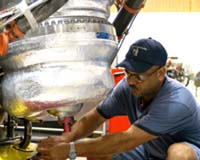
Cape Canaveral FL (SPX) Feb 18, 2005 When Tony Mendez looks at a Space Shuttle Main Engine (SSME), he sees a highly durable, specialized, complex machine that's done for more than 20 years exactly what it was designed to do. It propels the world's only reusable winged spaceships. Mendez is a Space Shuttle Main Engine (SSME) technical associate with Boeing Rocketdyne at NASA's Stennis Space Center (SSC). He is one of about 130 engineers and technicians who work with SSMEs on a daily basis. Their work is helping NASA carry out its plan to return the Space Shuttle to flight following the loss of Space Shuttle Columbia in February 2003. That plan plays a key role in NASA's Vision for Space Exploration, which includes completing work on the International Space Station by 2010. Mendez works on Stennis's A-2 Test Stand. His job on a recent afternoon included reading a mass spectrometer to ensure against leaks in the SSME heat exchanger. "I look at this engine a lot differently now than I did the first time I saw it 20 years ago," Mendez said. "Everything has its place. I can tell right away if something's not right." Mendez, who lives in Picayune, Miss., is not alone in his knowledge of the SSME, his longevity on the job or his dedication to it. "I make sure every time I do something, I do it 100 percent right," he said. "Every person working here feels the same way." "The Columbia accident really put us under a microscope," said Rene LeFrere of Slidell, La., an aerospace product technician with Boeing. "Of course, the accident had nothing to do with the engine, but it still makes us ask ourselves every day: 'Are we conducting the processes correctly? Are we paying attention to detail?' We don't take anything for granted." LeFrere works with Danny Wheat of Picayune, Miss., also an aerospace product technician, in Boeing's SSME warehouse and engine assembly facility, across the SSC campus from the A-2 Test Stand. Wheat has worked on SSMEs for 26 years. He compared the current Return to Flight initiative with that following the Challenger mishap in 1986. "These tragedies make you feel so helpless," Wheat said. "We're always careful, but after Columbia � and after Challenger � we became even more so. The astronauts go through so much to get up into space for themselves and for their country. You don't want to see anything get in the way of that." Because the lives of Space Shuttle astronauts depend on their vessels, Technician Don Albritton of Picayune sees it as his personal mission to make sure nothing erodes the astronauts' confidence in "his" engines. "Their lives are on the line," said the 11-year Boeing veteran. "What we do determines if their mission succeeds. It all boils down to assuring their safety. It makes me proud to be part of the team that accomplishes that goal." Terri Bennett, also of Picayune, echoed Albritton's sentiments. "We are a confident group. We all take pride in what we do." One of the first women to work in SSC's engine test complex, Bennett started nearly 20 years ago as a mechanic. She is now a Boeing lead quality inspector on the A-1 Test Stand. Dedication to the space program is a family tradition. Her father, James Bennett, started work at SSC (then called the Mississippi Test Facility) during the 1960s, when NASA was testing the Saturn engines that carried humans to the Moon. He retired from SSC in 1992. "The first time I saw a Space Shuttle launch, I was overcome with emotion," she said. "Especially right before the engines shut down, because up until that moment, it was MY engine. There is nothing like knowing you can take that thing apart and put it back together." Space Shuttle Discovery, NASA's Return to Flight mission STS-114, is scheduled to launch this year. While the orbiter Discovery undergoes extensive modification and maintenance at KSC in preparation for its return to flight, SSC engineers, mechanics and technicians will go quietly about their work, making sure "their" Space Shuttle Main Engines continue to operate safely and perform well. "This machine is so complex, but it works so flawlessly," Wheat said. "Our job is to make sure we work out any possible problem here � in processing or on the test stand � long before it gets to the launch pad or up into orbit." Community Email This Article Comment On This Article Related Links SpaceDaily Search SpaceDaily Subscribe To SpaceDaily Express Space Shuttle News at Space-Travel.Com
 Heads Up, Space Station, Discovery Is Ready To Blast Off
 Cape Canaveral (AFP) Jul 12, 2005
A plastic and foam cover fell off a window of Discovery, but damage to the space shuttle was rapidly fixed and will not cause any delays, NASA said Tuesday on the eve of the planned launch. |
|
|

| The content herein, unless otherwise known to be public domain, are Copyright 1995-2006 - SpaceDaily.AFP and UPI Wire Stories are copyright Agence France-Presse and United Press International. ESA PortalReports are copyright European Space Agency. All NASA sourced material is public domain. Additionalcopyrights may apply in whole or part to other bona fide parties. Advertising does not imply endorsement,agreement or approval of any opinions, statements or information provided by SpaceDaily on any Web page published or hosted by SpaceDaily. Privacy Statement |