|
 |
 |
 |
 |
 |
 |
 |
 |

 |
Pentagon Approves Missile Sales To Japan
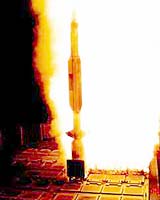
Washington (AFP) Jun 09, 2006 The US Department of Defense on Tuesday said it had approved the sale of nine interceptor missiles to Japan in a potential 458 million dollar deal. The sale of the nine SM-3 Block 1A Standard missiles with Ballistic Missile Defense upgrades has to be approved by the US Congress, which rarely blocks such deals once they have been backed by the Pentagon. "The proposed sale of the SM-3 missiles and BMD upgrades ... will not significantly alter the existing military balance in the region as the proposed sale enhances only defensive capabilities," the Department of Defense said in a statement. The AEGIS Weapon System and Standard missiles will be used on Japanese naval ships, and along with the Japanese navy Patriot PAC-3 missiles, will provide "the initial ballistic missile defense for mainland Japan." In mid-May Japanese ministers said that North Korea may be preparing to test-fire a long-range ballistic missile capable of hitting the US mainland. They were responding to media reports from Tokyo and Seoul that satellite data have shown increased movement by trailers and other vehicles near the Musudan-ri missile test site in northeastern North Korea, facing the Sea of Japan (East Sea). North Korea could fire for the first time a 35-meter (116-feet) Taepodong-2, which has a range of 3,500 to 6,000 kilometers (2,200 to 3,750 miles), officials said. Japanese Foreign Minister Taro Aso, however, doubted the launch would come immediately. North Korea is also believed to be developing the missile for a range of up to 10,000 kilometers (6,200 miles), which would put the continental United States within striking distance. North Korea shocked the world in August 1998 by firing a long-range Taepodong-1 missile with a range of up to 2,000 kilometers over Japan into the Pacific Ocean, claiming it was a satellite launch. It has since carried out a series of tests on smaller-range missiles. Tokyo has been in a hurry to bolster its missile defenses, and in March hailed the successful testing of an interceptor missile being researched with the United States. North Korea, which says it has nuclear arms, has refused to return to six-nation disarmament talks since November, protesting US financial sanctions against the impoverished regime over money-laundering and counterfeiting. According to South Korea, their Northern rivals have some 600 Scud missiles with a range of between 300 and 500 kilometers (between 190 and 310 miles), as well as 100 mid-range Rodong-1 missiles with a 1,300 kilometer range and able to hit the Japanese shores. Japan has been working with the United States on a missile defense shield since 1999. The system, which includes detection systems and interception missiles, is scheduled to be deployed in late 2006 or early 2007.
Source: Agence France-Presse Community Email This Article Comment On This Article Related Links - Learn about missile defense at SpaceWar.com All about missiles at SpaceWar.com
 US Weapon Plans Threaten Missile Proliferation
 Moscow (AFP) Jun 09, 2006
US plans to develop low-yield nuclear weapons and to use ballistic missiles for carrying conventional warheads are threatening the world's nuclear non-proliferation regime, Russian Foreign Minister Sergei Lavrov charged Wednesday. |
|
|

| The content herein, unless otherwise known to be public domain, are Copyright 1995-2006 - SpaceDaily.AFP and UPI Wire Stories are copyright Agence France-Presse and United Press International. ESA PortalReports are copyright European Space Agency. All NASA sourced material is public domain. Additionalcopyrights may apply in whole or part to other bona fide parties. Advertising does not imply endorsement,agreement or approval of any opinions, statements or information provided by SpaceDaily on any Web page published or hosted by SpaceDaily. Privacy Statement |