|
 |
 |
 |
 |
 |
 |
 |
 |

 |
Pegasus Set For Brazil EOsat Launch
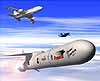
Dulles - October 16, 1998 - Orbital Sciences Corporation announced today that it is preparing to launch Brazil's Satellite de Coleta de Dados-2 (SCD-2) next week aboard the company's Pegasus(R) rocket in a mission that will originate from Cape Canaveral Air Station, Florida. The Pegasus rocket will also carry NASA's Wing Glove Experiment aboard its first stage to gather aerodynamic data related to hypersonic flight characteristics. The first opportunity to conduct the mission will be Thursday evening, October 22, with another launch opportunity available on Friday, October 23 if necessary. Orbital plans to launch the SCD-2 satellite into a circular orbit at an altitude of approximately 750 kilometers, inclined at 25 degrees to the equator. On Thursday, the available launch window extends from 7:57 p.m. to 9:29 p.m. EDT, with a targeted launch time of 8:02 p.m. EDT. The launch schedule is subject to final preparations and testing, as well as acceptable weather conditions at the launch site. The upcoming launch will represent the fifth Pegasus mission in 1998 and the 24th mission overall for the innovative airborne space launch system. This mission will also be the second Pegasus launch that Orbital has conducted for Brazil's national space agency. In February 1993, Orbital successfully launched Brazil's SCD-1 satellite, the predecessor spacecraft to SCD-2, in the third mission in the rocket program's history. To meet the mission schedule, Orbital's L-1011 Pegasus carrier aircraft is today conducting a cross-country ferry flight from Vandenberg Air Force Base, California, where the satellite, rocket and aircraft were integrated, to Cape Canaveral. This will be the first time that a Pegasus mission will originate and be controlled from Cape Canaveral. Over the next several days, Orbital's Pegasus team will complete the customary final tests and preparations for the mission. On the launch day, the mission sequence is planned to take approximately 10 minutes, from the time the Pegasus rocket is released from its carrier aircraft, about 100 nautical miles off the Florida coast, to the time that the satellite separates from the final stage of the Pegasus rocket. Following the launch, Orbital expects that it could take several hours before reliable data, gathered by ground tracking stations as the satellite passes overhead, can be assembled and reported on the basic status and health of the spacecraft. The SCD-2 Satellite The 254-pound SCD-2 satellite was built in Brazil by the Instituto Nacional de Pesquisas Espacial (INPE) of the country's Ministry of Space and Technology. Like its predecessor satellite, SCD-2 is designed to collect and relay environmental information gathered from ground sensors located in Brazil and other countries of the tropical belt within the Amazon River basin. The data collected by the ground sensors will assist environmentalists in their study of the South American rain forests. The Wing Glove Experiment The NASA Wing Glove Experiment is a small, specially contoured metallic aerodynamic surface wrapped closely around the inboard leading edge of the Pegasus wing surface. Its purpose is to measure the aerodynamic boundary layer transition from laminar to turbulent flow at hypersonic speeds, which reach Mach 8 during the first stage flight of the Pegasus rocket. The Wing Glove Experiment is completed about 90 seconds after the launch at an altitude of approximately 225,000 feet. As with all Pegasus missions, the rocket's first stage follows a suborbital trajectory and is not placed into orbit. The Pegasus Launch System Orbital's Pegasus rocket is the world's leading launch system for the deployment of small satellites into low-Earth orbit. Its patented air-launch system has enabled Orbital to conduct operations from five separate launch sites, including four sites in the U.S. and one in Europe, the first time a space launch vehicle has provided such operational flexibility. Pegasus is carried aloft by the company-owned L-1011 ``Stargazer'' aircraft to a launch point approximately 40,000 feet over open ocean areas, where it is released and then free-falls in a horizontal position for five seconds before igniting its first stage rocket motor. Updated Orbital Overview Orbital is one of the largest space and information systems companies in the world, with 1998 revenues of approximately $750 million. The company, which is headquartered in Dulles, Virginia, employs 4,200 people at its major facilities in eight states and several international locations. Orbital is the world's leading manufacturer of low-cost space systems and products, including satellites, launch vehicles, electronics and sensors, satellite ground systems and software, and satellite-based navigation and communications products. Through its ORBCOMM and ORBIMAGE subsidiaries, Orbital is also a pioneering operator of satellite networks that provide data communications and high-resolution imagery services to customers all around the world. Since its founding in 1982, Orbital (including several predecessor companies) has built and launched, or now has on order, nearly 390 small- and medium-class satellites and small launch vehicles. It has also produced over 15,000 space-related sensors and electronics systems and has installed satellite ground stations in more than 25 countries. The company's Magellan subsidiary is the world's premier producer of mobile satellite access products, offering the broadest line of products that use the U.S. Global Positioning System (GPS), from hand-held consumer models to high-precision units for industrial and scientific uses. Using GPS and other technologies, Magellan's PathMaster(TM) is the most popular car navigation system in the U.S. In addition, Magellan manufactures and sells state-of-the-art satellite communications products, including satellite telephones and hand-held personal messaging units for the ORBCOMM network. Finally, Orbital is now building a strong position in the rapidly growing market for satellite-delivered communications and imagery services through two affiliated companies. ORBCOMM is the world's first operational low-orbit satellite network for global data communications, recently completing the deployment of its basic constellation of 28 satellites. ORBIMAGE currently offers satellite-based Earth imaging services worldwide with two operational satellites, with two additional high-resolution digital imaging satellites planned to be in service over the next several years.
Orbital Sciences Reports From Spacer.Com
Email This Article Comment On This Article Related Links Space
 Satellite Launch To Boost DTH In India
 Calcutta, India (SPX) Dec 28, 2005
The successful launch Thursday of India's heaviest satellite from spaceport of Kourou in French Guyana may have boosted the country's space research efforts to yet another level, but it has also lifted the spirits of at least three Direct-To-Home televisions broadcasters, one of which has been waiting for years to launch its services in India. |
|
|

|
|
|
|
|
|
|
|
|
|
|
|
| The content herein, unless otherwise known to be public domain, are Copyright 1995-2006 - SpaceDaily.AFP and UPI Wire Stories are copyright Agence France-Presse and United Press International. ESA PortalReports are copyright European Space Agency. All NASA sourced material is public domain. Additionalcopyrights may apply in whole or part to other bona fide parties. Advertising does not imply endorsement,agreement or approval of any opinions, statements or information provided by SpaceDaily on any Web page published or hosted by SpaceDaily. Privacy Statement |