|
 |
 |
 |
 |
 |
 |
 |
 |

 |
Pegasus Does It Right Again
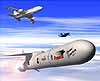
Dulles - May 18, 1999 - Orbital Sciences announced Tuesday that its Pegasus rocket successfully launched two satellites for U.S. Government customers in a mission carried out late Monday evening, May 17, from Vandenberg AFB. Orbital's Pegasus XL rocket accurately delivered the Tomographic Experiment using Radiative Recombinative Ionospheric EUV and Radio Sources (Terriers) satellite for the National Aeronautics and Space Administration (NASA). Later in the mission, Pegasus deployed the Multiple Path Beyond Line of Sight Communications (MUBLCOM) demonstration satellite into its targeted orbit for the U.S. Department of Defense's Advanced Research Programs Agency (DARPA). The Terriers/MUBLCOM mission was Orbital's second successful launch of the Pegasus rocket in 1999 and the 13th consecutive successful mission dating back to 1997. This mission also represented the 27th launch in the innovative air- launched rocket program's history, a depth of experience far greater than any other small commercial launch vehicle in the world. On Monday evening, the Terriers/MUBLCOM mission originated from VAFB, when the company's "Stargazer" L-1011 carrier aircraft took off at approximately 9:10 p.m. (PST). The aircraft flew about 100 nautical miles off the California coast at an altitude of 39,000 feet to a predetermined launch point over the Pacific Ocean. After being released from its carrier aircraft at 10:12 p.m. (PST), the Pegasus rocket ignited its first stage motor after a planned five-second free fall. Following an approximate 10-minute flight, Pegasus accurately delivered the Terriers satellite into its targeted circular orbit approximately 345 miles (550 kilometers) above the Earth, inclined at 97.75 degrees to the equator. Approximately 52 minutes later, Pegasus delivered the MUBLCOM satellite into its targeted circular orbit approximately 482 miles (775 kilometers) above the Earth, inclined at 97.75 degrees to the equator. Orbital has established initial communications with the company-built MUBLCOM satellite and preliminary indications are that its main operating systems are performing as expected. Orbital will continue its early in-orbit tests on the MUBLCOM satellite over the next several days. The MUBLCOM program is a partnership of Orbital, the Defense Advanced Research Projects Agency and the U. S. Army Communications-Electronics Command. It will demonstrate a unique new capability to provide space-based digital voice and data communications to combat forces or commercial users that were previously considered out of range of standard radio communications systems. Using UHF frequencies, the 105-pound (48-kilogram), Orbital-built MUBLCOM satellite will directly connect hand-held radios, also built by Orbital, that are beyond the line of sight from one another without the need for gateways or other terrestrial infrastructure. MUBLCOM's advanced technology will demonstrate how troops would be able to communicate securely and without interference over distances of more than 200 nautical miles, as well as in mountainous terrain and in cities where large buildings often limit contact. Additionally, during the demonstration, government users will be able to use the Orbital hand-held radios to link to the Internet to download data or to send messages. In addition to its military utility, the MUBLCOM program has potential commercial applications in providing networked communications for disaster relief workers, forest firefighters, police forces and drug enforcement personnel. The MUBLCOM system will demonstrate a combination of coverage, performance, functionality and affordability that is unequaled by existing or proposed satellite communications systems. The Terriers satellite program is part of NASA's Student Explorer Demonstration Initiative, which is administered by the Universities Space Research Association and is designed to make space science more accessible to students. Led by Boston University, the Terriers team includes AeroAstro, Inc., the Naval Research Laboratory and the Massachusetts Institute of Technology's Haystack Observatory. The 274-pound (125-kilogram) Terriers satellite will survey the Earth's upper atmosphere using a technique called tomography, measuring ultraviolet light emissions to create unprecedented three-dimensional images of the Earth's ionosphere. These studies will allow scientists to better predict space weather conditions in the ionosphere that could disrupt vital communications systems on Earth. As of press time NASA had reported problems with the deployment of the solar arrays on Terriers and mission control at Boston University and NASA were assessing the situation.
Email This Article Comment On This Article Related Links Space
 Satellite Launch To Boost DTH In India
 Calcutta, India (SPX) Dec 28, 2005
The successful launch Thursday of India's heaviest satellite from spaceport of Kourou in French Guyana may have boosted the country's space research efforts to yet another level, but it has also lifted the spirits of at least three Direct-To-Home televisions broadcasters, one of which has been waiting for years to launch its services in India. |
|
|

|
|
|
|
|
|
|
|
|
|
|
|
| The content herein, unless otherwise known to be public domain, are Copyright 1995-2006 - SpaceDaily.AFP and UPI Wire Stories are copyright Agence France-Presse and United Press International. ESA PortalReports are copyright European Space Agency. All NASA sourced material is public domain. Additionalcopyrights may apply in whole or part to other bona fide parties. Advertising does not imply endorsement,agreement or approval of any opinions, statements or information provided by SpaceDaily on any Web page published or hosted by SpaceDaily. Privacy Statement |