|
 |
 |
 |
 |
 |
 |
 |
 |

 |
Peering Into The Pillars Of Creation
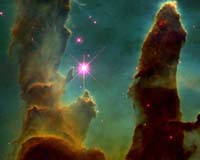
Boston MA (SPX) Feb 16, 2007 A new look at the famous "Pillars of Creation" with NASA's Chandra X-ray Observatory has allowed astronomers to peer inside the dark columns of gas and dust. This penetrating view of the central region of the Eagle Nebula reveals how much star formation is happening inside these iconic structures. The Chandra data shows bright X-ray sources in this field, most of which are young stars. Very few X-ray sources are found in the pillars themselves. This suggests that the Eagle Nebula may be past its star-forming prime, since young stars are usually bright X-ray sources. However, there are two X-ray objects found near the tips of the pillars. One is a young star about 4 or 5 times as massive as the Sun, visible as the blue source near the tip of the pillar on the left. The other is a lower mass star near the top of the other pillar that is so faint it is not visible in the composite image. The Chandra observations did not detect X-rays from any of the so-called evaporating gaseous globules, or EGGs. The EGGs are dense, compact pockets of interstellar gas where stars are believed to be forming. The lack of X-rays from these objects may mean that most of the EGGs do not contain enshrouded stars. However, infrared observations have shown that 11 of the 73 EGGs contain infant stellar objects and 4 of these are massive enough to form a star. The stars embedded in these 4 EGGs might be so young that they have not generated X-rays yet and one of them - estimated to have about the mass of the Sun - could represent one of the earliest stages of evolution of our nearest star. The Sun was likely born in a region like the Pillars of Creation. The pillars and the few stars forming inside them are the last vestiges of star formation in the Eagle Nebula, also known as M16, which peaked several million years earlier. This contrasts strongly with the active star forming regions in other clusters such as NGC 2024, where Chandra sees a dense cluster of embedded young stars. The results were published in the January 1st issue of The Astrophysical Journal and the research team, led by Jeffrey Linsky of the University of Colorado, includes Marc Gagne and Anna Mytyk (West Chester University), Mark McCaughrean (University of Exeter) and Morten Andersen (University of Arizona). Community Email This Article Comment On This Article Related Links Chandra X-ray Center Stellar Chemistry, The Universe And All Within It Stellar Chemistry, The Universe And All Within It
 The Colorful Demise of a Sun-Like Star
 Pasadena CA (SPX) Feb 14, 2007
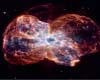
A new image from NASA's Hubble Space Telescope shows the colorful "last hurrah" of a star like our sun. The picture was taken on Feb. 6, 2007, by Hubble's Wide Field and Planetary Camera 2, which was designed and built by NASA's Jet Propulsion Laboratory, Pasadena, Calif. |
|
|

| The content herein, unless otherwise known to be public domain, are Copyright 1995-2006 - SpaceDaily.AFP and UPI Wire Stories are copyright Agence France-Presse and United Press International. ESA PortalReports are copyright European Space Agency. All NASA sourced material is public domain. Additionalcopyrights may apply in whole or part to other bona fide parties. Advertising does not imply endorsement,agreement or approval of any opinions, statements or information provided by SpaceDaily on any Web page published or hosted by SpaceDaily. Privacy Statement |