|
 |
 |
 |
 |
 |
 |
 |
 |

 |
Peeling Back The Skin Of Mars Meter By Meter
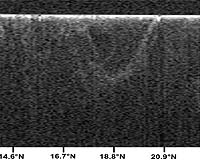
Paris, France (ESA) Dec 27, 2006 Scientists are finding an older, craggier face of Mars buried beneath the surface, thanks to pioneering sounding radar co-sponsored by NASA aboard the European Space Agency's Mars Express spacecraft. Observations by the first project to explore a planet by sounding radar strongly suggest that ancient impact craters lie buried beneath the smooth, low plains of Mars' northern hemisphere. The technique uses echoes of waves that have penetrated below the surface. "It's almost like having X-ray vision," said Dr. Thomas R. Watters of the National Air and Space Museum's Center for Earth and Planetary Studies, Washington. "Besides finding previously unknown impact basins, we've also confirmed that some of the subtle topographic depressions mapped previously in the lowlands are related to impact features." Studies of how Mars evolved aid understanding of early Earth. Some signs of the forces at work a few billion years ago are more evident on Mars because, on Earth, many of them have been obliterated during Earth's more active resurfacing by tectonic activity. Studying the geological history of Mars can also help scientists determine whether or not the Martian environment was ever capable of supporting life as we know it. Watters and nine co-authors reported the findings in the Dec. 14, 2006 issue of the journal Nature. The researchers used the orbiter's Mars Advanced Radar for Subsurface and Ionospheric Sounding, which was provided to the European Mars mission by NASA and the Italian Space Agency. The instrument transmits radio waves that pass through the Martian surface and bounce off features in the subsurface with electrical properties that contrast with those of materials that buried them. The findings bring planetary scientists closer to understanding one of the most enduring mysteries about the geologic evolution of the planet. In contrast to Earth, Mars shows a striking difference between its northern and southern hemispheres. Almost the entire southern hemisphere has rough, heavily cratered highlands, while most of the northern hemisphere is smoother and lower in elevation. Since the impacts that cause craters can happen anywhere on a planet, the areas with fewer craters are generally interpreted as younger surfaces where geological processes have erased the impact scars. The abundance of buried craters that the radar has detected beneath Mars' smooth northern plains means the underlying crust of the northern hemisphere is extremely old, "perhaps as ancient as the heavily cratered highland crust in the southern hemisphere." Learning about the ancient lowland crust has been challenging because that crust was buried first by vast amounts of volcanic lava and then by sediments carried by episodic flood waters and wind. Community Email This Article Comment On This Article Related Links Mars Express at ESA MARSIS Smithsonian National Air and Space Center for Earth and Planetary Studies Mars News and Information at MarsDaily.com Mars News and Information at MarsDaily.com Lunar Dreams and more
 ESA Polls Stakeholders To Inform Its Long-Term Exploration Strategy
 Paris, France (ESA) Dec 20, 2006
Early next year in the historic town of Edinburgh, ESA and BNSC are to hold a workshop to kick off the first in a series of consultations with key stakeholders. The aim is to define European long-term strategy for space exploration and set the scene for the decisions to be taken at the ESA Council meeting at ministerial level scheduled for 2008. |
|
|

| The content herein, unless otherwise known to be public domain, are Copyright 1995-2006 - SpaceDaily.AFP and UPI Wire Stories are copyright Agence France-Presse and United Press International. ESA PortalReports are copyright European Space Agency. All NASA sourced material is public domain. Additionalcopyrights may apply in whole or part to other bona fide parties. Advertising does not imply endorsement,agreement or approval of any opinions, statements or information provided by SpaceDaily on any Web page published or hosted by SpaceDaily. Privacy Statement |