|
 |
 |
 |
 |
 |
 |
 |
 |

 |
Patching Titan's Surface View
Moffet Field CA (SPX) Jun 30, 2004 Irregular bright and dark regions of yet unidentified composition and character are becoming increasingly visible on Titan's surface as Cassini approaches its scheduled first flyby of Saturn's largest moon on July 2,2004. This view represents an improvement in resolution of nearly three times over the previous Cassini images of Titan. Titan's surface is difficult to study, veiled by a dense hydrocarbon haze that forms in the high stratosphere as methane is destroyed by sunlight. This image is different from previous Titan images by Cassini because it was taken through a special filter, called a polarizer, which is designed to see through the atmosphere to the surface. In the near-infrared the polarizing filter is centered at 938 nanometers. The combination was designed to reduce the obscuration by atmospheric haze. The haze is more transparant at 938 nm than it is at shorter wavelengths and light of 938 nm wavelength is not absorbed by methane gas in Titan's atmosphere. Light at this wavelength consequently samples the surface, and the polarizer blocks out light scattered mainly by the haze. This is similar to the way a polarizer, put on the front of a lens of a hand-held camera, makes distant objects more clear on the Earth. The superimposed coordinate system grid in the accompanying image at right illustrates the geographical regions of the moon that are illuminated and visible, as well as the orientation of Titan - north is up and rotated 25 degrees to the left. The yellow curve marks the position of the boundary between day and night on Titan. This image shows about one quarter of Titan's surface, from 0 to 70 degrees West longitude, and just barely overlaps part of the surface shown in the previous Titan image release. Most of the visible surface in this image has not yet been shown in any Cassini image release. The image was obtained with the narrow angle camera on June 14, 2004, at a phase, or Sun-Titan-spacecraft, angle of 61 degrees and at a distance of 10.4 million kilometers (6.5 million miles) from Titan. The image scale is 62 kilometers (39 miles) per pixel. The image was magnified by a factor of two using a linear interpolation scheme. Cassini will conduct a critical 96-minute burn before going into orbit around Saturn on June 30 (July 1 Universal Time), with its first scheduled flyby of Titan on July 2. Community Email This Article Comment On This Article Related Links SpaceDaily Search SpaceDaily Subscribe To SpaceDaily Express Explore The Ring World of Saturn and her moons Jupiter and its Moons The million outer planets of a star called Sol News Flash at Mercury
 Titan's Methane Mystery
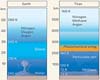 Moffett Field CA (SPX) Dec 12, 2005
The methane giving an orange hue to Saturn's giant moon Titan likely comes from geologic processes in its interior according to measurements from the Gas Chromatograph Mass Spectrometer (GCMS), a Goddard Space Flight Center instrument aboard the European Space Agency's Huygens Probe. |
|
|

| The content herein, unless otherwise known to be public domain, are Copyright 1995-2006 - SpaceDaily.AFP and UPI Wire Stories are copyright Agence France-Presse and United Press International. ESA PortalReports are copyright European Space Agency. All NASA sourced material is public domain. Additionalcopyrights may apply in whole or part to other bona fide parties. Advertising does not imply endorsement,agreement or approval of any opinions, statements or information provided by SpaceDaily on any Web page published or hosted by SpaceDaily. Privacy Statement |