|
 |
 |
 |
 |
 |
 |
 |
 |

 |
Palomar Movie Tracks Crumbling Comet
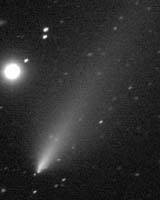
Palomar Mountain CA (SPX) May 14, 2006 Astronomers tracking 73P/Schwassmann-Wachmann's passage through the nearby part of the solar system have collected enough images to create a movie of the comet's disassembly. Eran Ofek of the California Institute of Technology and Bidushi Bhattacharya of Caltech's Spitzer Science Center compiled the movie using the Palomar Observatory's 200 inch Hale Telescope. The comet, discovered by German astronomers Arnold Schwassmann and Arno Arthur Wachmann 76 years ago, had broken into four fragments a decade ago. Since then, and most recently, it has split into dozens of pieces. "We've learned that Schwassmann-Wachmann 3 presents a very dynamic system, with many smaller fragments than previously thought," Bhattacharya said. In all, 16 new fragments were discovered as a part of the Palomar observations. A sequence of images showing the piece of the comet known as fragment R has been assembled into a movie. The movie shows the comet in the foreground against distant stars and galaxies, which appear to streak across the images. Because the comet was moving at a different rate across the sky than the stellar background, the telescope was tracking the comet's motion and not that of the stars. Fragment R and many smaller fragments of the comet are visible as nearly stationary objects in the movie. "Seeing the many fragments was both an amazing and sobering experience," said Ofek, who has been working non-stop to produce the movie of the comet's fragments. The astronomers collected the images over about an hour and a half, when Schwassmann-Wachmann 3 was about 17 million kilometers (10.6 million miles) from Earth. The closest approach occurred last Friday, when a fragment passed just 5.5 million miles from Earth � still more than 20 times the distance to the Moon, however. "It is very impressive that a telescope built more than 50 years ago continues to contribute to forefront astrophysics, often working in tandem with the latest space missions and biggest ground-based facilities," said astronomer and planetary scientists Shri Kulkarni of the Caltech Optical Observatories. The astronomers coordinated the Palomar observations with observations acquired by the Spitzer Space Telescope, which imaged the comet's fragments in the infrared. The infrared images, combined with the visible-light images obtained using the Hale instrument, should give astronomers a more complete understanding of the comet's break up. Community Email This Article Comment On This Article Related Links Comet Breakup Movie Asteroid and Comet Mission News, Science and Technology
 Spitzer Telescope Sees Trail of Comet Crumbs
 Los Angeles CA (SPX) May 11, 2006
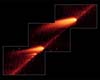
NASA's Spitzer Space Telescope has snapped a picture of the bits and pieces making up Comet 73P/Schwassman-Wachmann 3, which is continuing to break apart on its periodic journey around the sun. The new infrared view shows several chunks of the comet riding along its own dusty trail of crumbs. |
|
|

| The content herein, unless otherwise known to be public domain, are Copyright 1995-2006 - SpaceDaily.AFP and UPI Wire Stories are copyright Agence France-Presse and United Press International. ESA PortalReports are copyright European Space Agency. All NASA sourced material is public domain. Additionalcopyrights may apply in whole or part to other bona fide parties. Advertising does not imply endorsement,agreement or approval of any opinions, statements or information provided by SpaceDaily on any Web page published or hosted by SpaceDaily. Privacy Statement |