|
 |
 |
 |
 |
 |
 |
 |
 |

 |
Paleontologists Find 67 Dinosaurs In One Week Across Gobi Desert
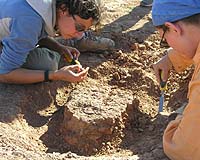
Bozeman MT (SPX) Sep 18, 2006 One recent week in the Gobi Desert produced 67 dinosaur skeletons for a team of paleontologists from Montana and Mongolia who want to flesh out the developmental biology of dinosaurs. Montana State University paleontologist Jack Horner said Wednesday that the same area yielded 30 skeletons last year, so researchers at MSU and Mongolia's Science and Technology University now have about 100 Psittacosaurus skeletons. The skeletons ranged in length from one to five feet and stood about two feet tall. "That's what I was there for -- getting as many of those as we could possibly get," Horner said as he waited for the rest of the MSU team to return to Bozeman. He was specifically looking for Psittacosaurus fossils because it was a very common dinosaur and would give him lots of specimens, Horner said. It would also keep away poachers and commercial fossil hunters who work in the area, but prefer rare fossils. Horner wants a large number of fossils so he can compare variations between skeletons and changes during growth. The Psittacosaurus dinosaur, also known as a "parrot lizard," was a plant-eater that lived about 120 million years ago in the Early Cretaceous Period, Horner said. It was an ancestor of horned dinosaurs like the triceratops. "The reason I went after Psittacosaurus was because I figured I could get more of those dinosaurs in the shortest period of time than any other dinosaur," Horner added. Horner and his group left near the end of August for Mongolia. Joined there by Bolortsetseg Minjin and her team of Mongolian students, the paleontologists drove two days out of Ulan Bator. There, in a few square miles of badlands, they worked from sun-up to sundown and collected dozens of fossils. This summer's fossils have all been excavated and are now at the Mongolian university, Horner said. Jamie Cornish, marketing director at MSU's Museum of the Rockies, said the bones belong to Mongolia, but Horner may obtain casts of them. Horner added that he will be able to study some of the fossils in Montana, but they will be returned to Mongolia. "We can bring specimens here for a little while, but the Museum of the Rockies is not the place for bones from other countries," Horner said. "We have enough stuff." The Mongolian dig is funded by Nathan Myhrvold and will continue next summer, Horner said. Myhrvold is a member of the Museum of the Rockies National Advisory Board and a major supporter of paleontology research in Eastern Montana. The Mongolian project is a joint research project with Mongolia's Science and Technology University. It's also designed to help the Mongolian university develop its paleontology program for students. It will include the construction of a preparation lab and a small museum in Mongolia. "This project is primarily for the benefit of Mongolia, looking for specimens for them to put in a museum we're going to encourage them to build," Horner said. He added that the museum project is similar to an effort at Rudyard in northern Montana. The paleontologists found two meat-eating fossils in Mongolia in addition to the Psittacosaurus, Horner said. One of them looked like a raptor and may be a new species, but Horner said, "We find new species all the time. ... A hundred Psittacosauruses are a lot more interesting to me than new species." Community Email This Article Comment On This Article Related Links Montana State University Darwin Today At TerraDaily.com Darwin Today At TerraDaily.com
 California Scientists Find Natural Way To Control Spread Of Destructive Argentine Ants
 San Francisco, CA (SPX) Sep 15, 2006
Pesticides haven't stopped them. Trapping hasn't worked, either. But now chemists and biologists at the University of California, Irvine, (UCI) think they may have found a natural way to finally check the spread of environmentally destructive Argentine ants in California and elsewhere in the United States: Spark a family feud. |
|
|

| The content herein, unless otherwise known to be public domain, are Copyright 1995-2006 - SpaceDaily.AFP and UPI Wire Stories are copyright Agence France-Presse and United Press International. ESA PortalReports are copyright European Space Agency. All NASA sourced material is public domain. Additionalcopyrights may apply in whole or part to other bona fide parties. Advertising does not imply endorsement,agreement or approval of any opinions, statements or information provided by SpaceDaily on any Web page published or hosted by SpaceDaily. Privacy Statement |