|
 |
 |
 |
 |
 |
 |
 |
 |

 |
Pakistan, Indian Say Nukes Safe After Quake
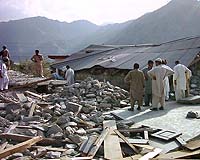
Islamabad (AFP) Oct 11, 2005 Rivals Pakistan and India said their nuclear warheads and installations were safe after the weekend's devastating earthquake which caused major casualties on both sides. The South Asian neighbours conducted tit-for-tat atomic tests in 1998 and in 2002 came to the brink of war along their ceasefire line in the divided Himalayan territory of Kashmir, the area worst hit by Saturday's 7.6 magnitude quake. "There is no danger to our nuclear installations and weapons from earthquakes," Pakistan military spokesman major general Shaukat Sultan told AFP. "They are fully safe." Sultan said he was not immediately able to say up to what intensity the Pakistani nuclear facilities could withstand earthquakes and aftershocks. Indian government officials declined to comment on the status of their atomic bombs but Indian defence experts said no warheads are deployed anywhere near the border with Pakistan. Separately, the Nuclear Power Corporation of India Limited said they had "not received any reports of any damage to any of our facilities". India's 15 nuclear power plants also withstood a giant quake in Gujarat in January 2001, the corporation's website said. Up to 40,000 people are thought to have died in Pakistan from the weekend's monster quake, many of them in Pakistani Kashmir, and a further 950 have been confirmed dead in India's sector of the region. The quake also caused massive structural damage, wiping out whole villages and laying waste to some 75 percent of Muzaffarabad, capital of Pakistani Kashmir. Pervez Hoodbhoy, professor of physics at Islamabad's Quaid-i-Azam University, said the quake posed more danger to nuclear power plants than the nuclear weapons. Pakistan's main uranium enrichment facility in Kahuta, near Islamabad, is located about 75 kilometres (46 miles) southeast of Kashmir. "It will not be a military installation, the danger could be at Chashma," Hoodbhoy, also an activist against nuclear weapons, told AFP refering to a Chinese-built facility some 400 kilometres (248 miles) southwest of Islamabad. "Chashma is in a seismic zone and if an earthquake is centred close to it (the nuclear power plant) there could be loss of radioactive material and a Chernobyl like situation," Hoodbhoy said. India and Pakistan have fought three wars since their bloody partition in 1947 but they launched a peace process in January 2004 that renewed cultural, sports and economic links snapped in 2002. The two countries had poured troops onto their border in 2002 following an attack by suspected Pakistan-backed militants on India's parliament. India blamed Pakistan for the attack, but Islamabad denied the charge. They have since been involved in peace talks including confidence-building measures to avoid an accidental nuclear war between them. Community Email This Article Comment On This Article Related Links SpaceDaily Search SpaceDaily Subscribe To SpaceDaily Express Learn about nuclear weapons doctrine and defense at SpaceWar.com Learn about missile defense at SpaceWar.com All about missiles at SpaceWar.com Learn about the Superpowers of the 21st Century at SpaceWar.com
 World Powers Threaten Defiant Iran Over Nuclear Crisis
 Vienna (AFP) Jan 11, 2006
World powers threatened Iran with UN Security Council sanctions Wednesday after it resumed sensitive nuclear activities as a defiant Tehran vowed to press ahead with its disputed atomic programme. |
|
|

| The content herein, unless otherwise known to be public domain, are Copyright 1995-2006 - SpaceDaily.AFP and UPI Wire Stories are copyright Agence France-Presse and United Press International. ESA PortalReports are copyright European Space Agency. All NASA sourced material is public domain. Additionalcopyrights may apply in whole or part to other bona fide parties. Advertising does not imply endorsement,agreement or approval of any opinions, statements or information provided by SpaceDaily on any Web page published or hosted by SpaceDaily. Privacy Statement |