|
 |
 |
 |
 |
 |
 |
 |
 |

 |
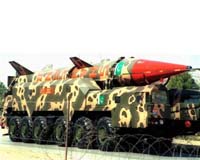
Pakistan Successfully Tests Nuclear-Capable Missile
Islamabad (AFP) Feb 23, 2007 Pakistan Friday test-fired its longest range nuclear-capable ballistic missile, two days after signing a deal with rival India to cut the risk of atomic weapons accidents, the military said. The Shaheen II, or Hatf VI, missile with a range of 2,000 kilometres (1,240 miles) was launched from an undisclosed location, military spokesman Major General Shaukat Sultan told AFP. "The test was very successful. It was carried out to validate technical parameters and it hit the target with 100 percent accuracy," Sultan said. "It is a two-stage solid-fuel-based missile capable of carrying all types of warhead including nuclear." Pakistan had informed "neighbouring countries" in advance about the missile test, foreign office spokeswoman Tasnim Aslam said. Pakistan is bordered by India, Afghanistan, China and Iran. "We conduct these tests from time to time according to our requirement and defence needs. It was not meant to convey any message to anyone. It was not any country-specific," she said. Pakistan President Pervez Musharraf and Prime Minister Shaukat Aziz congratulated the missile's technical team "on its outstanding success," a military statement said. "The missile test was part of (a) continuous process of validation and technical improvement, which Pakistan follows to consolidate and verify its various land-based strategic missile systems," the statement said. The test comes at a key time in relations between New Delhi and Islamabad following the firebombing of a cross-border train at midnight Sunday, which killed 68 Pakistanis and Indians. Pakistan Foreign Minister Khurshid Kasuri went ahead with a visit to India starting on Tuesday, during which the two countries signed the nuclear weapon safeguard agreement. Friday's missile launch was watched by Pakistan's Chairman of Joint Chiefs of Staff General Ehsan Ul Haq, who said the test was "an important milestone in Pakistan's quest for sustaining strategic balance in South Asia." India and Pakistan carried out tit-for-tat nuclear detonations in May 1998 and have routinely conducted missile tests since, even after the start of a slow-moving peace process in January 2004. The neighbours have fought three wars since independence from Britain in 1947, two of them over the disputed Himalayan territory of Kashmir, which is divided between the two and claimed by both in its entirety.
Source: Agence France-Presse Community Email This Article Comment On This Article Related Links All about missiles at SpaceWar.com Learn about missile defense at SpaceWar.com All about missiles at SpaceWar.com
 Rumsfeld's Missile Bungle
 Arlington (UPI) Feb 21, 2007
Here's a fantasy. Imagine three military services agreed on the need for a versatile air-to-ground missile that could precisely destroy a wide range of elusive targets -- everything from camouflaged armored vehicles to terrorist speedboats. Imagine they found a low-cost design that could do those things day or night, good weather or bad, even when enemies were trying to jam the missile. |
|
|

| The content herein, unless otherwise known to be public domain, are Copyright 1995-2006 - SpaceDaily.AFP and UPI Wire Stories are copyright Agence France-Presse and United Press International. ESA PortalReports are copyright European Space Agency. All NASA sourced material is public domain. Additionalcopyrights may apply in whole or part to other bona fide parties. Advertising does not imply endorsement,agreement or approval of any opinions, statements or information provided by SpaceDaily on any Web page published or hosted by SpaceDaily. Privacy Statement |