|
 |
 |
 |
 |
 |
 |
 |
 |

 |
Pakistan Battles Weather To Aid Quake Victims
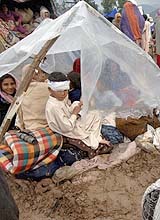
Muzaffarabad, Pakistan (AFP) Oct 11, 2005 Pakistan on Tuesday battled to get food and shelter to millions of earthquake victims left exposed to brutal conditions from the worst natural disaster in the nation's history. Officials said the death toll from Saturday's quake had hit 23,000 with as many as 60,000 injured, grim numbers yet far short of the expected final tally, as hopes dimmed of finding anyone still clinging to life under the rubble. Some rescue teams simply gave up while others were blocked from reaching the worst affected areas in Pakistani-held Kashmir, hampered by lashing rains that conjured fears of more landslides and grounded relief flights for hours. The bodies of the unburied dead lined the streets of the ruined Kashmiri town of Muzaffarabad, buzzing with flies as Pakistani army soliders -- wearing masks to fight the awful stench -- tried to gather them with dignity. "I don't recognise Muzaffarabad any more," said 19-year-old student Daniel Shahaad, who had survived on only biscuits and milk since the 7.6-maginutde quake devastated his hometown. "Now we are street people -- like those who you see in big cities, living on the streets," he said. Lorries carrying tonnes of tents, medicine and food, much of it donated by an international community stunned by the scope of the disaster, inched their away along Kashmir's broken roads in a race against the clock. But aid helicopters, needed to bring supplies to the most distant victims in the region's difficult mountain terrain, were suspended for two hours by monsoon rains that pelted the suffering victims of the tragedy. The choppers, including giant US military Chinooks, spent part of the day making regular flights to bring aid and evacuate the injured from Muzaffarabad, the Pakistani Kashmir capital, an AFP correspondent said. After the delay the flights resumed but among what Pakistan said were 2.5 million left homeless by the quake, scuffles broke out over scant supplies in a region grappling to make sense of the enormity of the destruction. "Whole cities have been annihilated," Prime Minister Shaukat Aziz said. "It's a mammoth exercise in logistics, it's a mammoth exercise in coordination. It's a mammoth exercise in every respect of human endurance." Just a handful of the fortunate received the best possible news. In Pakistan's capital, Islamabad, two women were pulled out alive by a British rescue team that heard their faint voices under a collapsed apartment block nearly 80 hours after the earthquake struck. But for countless others, the fourth full day after the quake brought sad confirmation that their loved ones were gone forever. Before soldiers lifted a makeshift stretcher in Muzaffarabad holding the body of 20-year-old Raja Naveed Afzal to their shoulders, his uncle Shah Zamman chanted verses from the Koran, shed some tears and then bade the boy farewell. In the wrecked town of Bakalot, Colonel Jean-Jacques Mornat of France's Civil Security said five children had been recovered alive from a school but said no more could be recovered. "Our rescue work here is finished. The phase of bulldozing and sanitising these areas is going to start," he said. Asked if there was any chance of finding more survivors, Mornat replied: "No, there is no hope." Prime Minister Aziz said 2.5 million needed new housing and were facing the reality of exposure to rains and cold now and a freezing winter coming soon. "Our priorities for foreign assistance are first, financial, so then we can buy locally and send quickly," he said. "Second would be tents. Third would be blankets. Fourth would be medicines and medical equipment -- fifth would be engineering equipment to rebuild." Officials said the United States had agreed to send 24 more Chinook helicopters to the eight choppers it had already provided. The United Nations warned of "enormous logistical difficulties" because of the rugged terrain, where landslides had cut many roads, allowing access only by foot or by helicopter. The world body issued a "flash appeal" for more than 270 million dollars to add to the hundreds of millions already pledged by the international community. NATO said it would organize an airlift of humanitarian aid. The first plane will be loaded with supplies on Wednesday in Slovenia, an official from the Western military alliance told AFP. But as the United Nations said around 1,000 hopsitals in Pakistan had been "completely destroyed," the victims awaited help from any quarter -- as much and as soon as possible. "The devastation has created major obstacles in urgently helping the thousands of injured people to get the medical care they need," the World Health Organisation said. "Many health workers -- including doctors and nurses -- have died or been seriously injured," it said. The UN High Commissioner for Refugees said that refugees from Afghanistan were also likely among the dead. On the Indian side of divided Kashmir, officials said the death toll had hit 1,300. India, Pakistan's longtime rival and nuclear neighbour, was sending 25 tonnes of supplies in the first such aid delivery in decades. But the first cargo plan carrying medicines, blankets and tents had to turn back because there was no room for it to park at the Islamabad airport, the air force said. Community Email This Article Comment On This Article Related Links SpaceDaily Search SpaceDaily Subscribe To SpaceDaily Express Bringing Order To A World Of Disasters A world of storm and tempest When the Earth Quakes
 ISRO Developing Ocean Bottom Warning Sensors
 Bangalore, India (SPX) Jan 11, 2006
Indian Space Research Organisation is developing ocean bottom sensors that will help warn tsunami strikes in advance, the Press Trust Of India reports. |
|
|

| The content herein, unless otherwise known to be public domain, are Copyright 1995-2006 - SpaceDaily.AFP and UPI Wire Stories are copyright Agence France-Presse and United Press International. ESA PortalReports are copyright European Space Agency. All NASA sourced material is public domain. Additionalcopyrights may apply in whole or part to other bona fide parties. Advertising does not imply endorsement,agreement or approval of any opinions, statements or information provided by SpaceDaily on any Web page published or hosted by SpaceDaily. Privacy Statement |