|
 |
 |
 |
 |
 |
 |
 |
 |

 |
PNG Volcano Could Be Facing Massive Blow
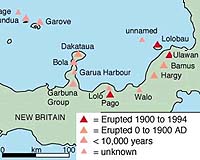
London (AFP) Oct 10, 2002 A volcano in Papua New Guinea is showing signs of a catastrophic eruption that could threaten tens of thousands of lives and temporarily affect the Earth's climate with its dust plume, New Scientist says. Part of the volcano's system has been pumping out lava and disgorging rocks and ash for more than two months, and 15,000 people have been evacuated, the British science weekly says. But experts are worried that these rumblings are merely signs of much worse to come, it says. Pago, the volcano that has been making the noises, has erupted at least eight times in the past 500 years, most recently in 1933, which forced many people from their homes and sparked a famine. What makes Pago special is that it is the active vent, or safety valve, for a caldera, one of the most dangerous types of volcano. That volcano, Witori, has erupted more than 10 times in the past 5,600 years, sometimes spewing up to four times as much debris as the 1991 eruption of Mount Pinatubo in the Philippines. "Witori's last big show was just under 500 years ago, and scientists are worried that the caldera could be due for another big event," the report, carried in next Saturday's issue of New Scientist, says. "A large explosion could send flows of hot ash and debris up to 30 m away, endangering up to 30,000 people and would temporarily change the Earth's climate." The US Geological Survey's Disaster Assistance Program flew a three-member emergency team to the area last month at the request of the Papuan government. The experts are setting up a network of seismic and global positioning system (GPS) sensors to monitor ground movement at Pago. Caldera volcanoes are types of volcano which have a large crater that sits on the magma chamber below, like a sealed lid on a kettle. When pressure builds up beyond a certain point, they can erupt with an earth-shaking power equal to many nuclear bombs. One such volcano was Krakatoa. When it erupted in 1883, it unleashed a tidal wave that reached as far as Aden in the Middle East. Its airborne dust caused spectacular sunsets as far away as New York and lowered the global atmospheric temperature by as much as 1.2 degrees celsius over the following five years. Community Email This Article Comment On This Article Related Links SpaceDaily Search SpaceDaily Subscribe To SpaceDaily Express Tectonic Science and News
 Ash Continuing To Spew From Vanuatu Volcano
 Sydney (AFP) Dec 12, 2005
Thousands of tonnes of ash are continuing to spew from a volcano in Vanuatu, but officials said Monday the activity on the South Pacific nation was not likely to result in a major deadly eruption. |
|
|

| The content herein, unless otherwise known to be public domain, are Copyright 1995-2006 - SpaceDaily.AFP and UPI Wire Stories are copyright Agence France-Presse and United Press International. ESA PortalReports are copyright European Space Agency. All NASA sourced material is public domain. Additionalcopyrights may apply in whole or part to other bona fide parties. Advertising does not imply endorsement,agreement or approval of any opinions, statements or information provided by SpaceDaily on any Web page published or hosted by SpaceDaily. Privacy Statement |