|
 |
 |
 |
 |
 |
 |
 |
 |

 |
Ozone And Uv Over Europe: No Sign Of Improvement
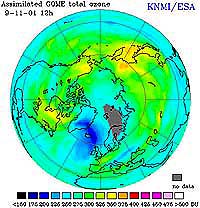
Paris - Jan 29, 2002 "The occurrence of ozone mini-holes over Europe increases and any ozone layer recovery could only become measurable around 2010 at the earliest" concludes an assessment report, released today, on European research in the stratosphere. The report concerns loss of ozone, increases in ultraviolet radiation as well as the impact of aircraft on the atmosphere. It covers European research efforts during the period 1996-2000 including the Third European Stratospheric Experiment on Ozone -- THESEO, which is the biggest EU-supported campaign ever to study the ozone layer. Commissioner for Research Philippe Busquin said: "The assessment results shows once more how important studies such as THESEO are in order to understand ozone loss and the resulting increase in harmful sunlight radiation. "An international campaign like THESEO also clearly demonstrates that a close integration of European and national programmes provides great benefits for science and for carrying forward the EU's policies. When properly organised at a European scale, our research can play a major role in solving environmental problems of a global dimension." Based on new scientific findings, the assessment concludes that the possibility of severe ozone losses over the Arctic and Europe remains high, due to slow chlorine decreases and the current increase of bromine concentrations, which will ultimately contribute to this loss. The observed cooling of the stratosphere due to ozone depletion and greenhouse gas emissions further increase these ozone losses and changes in atmospheric circulation. The circulation changes are responsible for the increase of ozone mini-holes over Europe. Future UV radiation doses will depend on these ozone losses and additionally on cloudiness, snow and ice cover which are affected by climate change. In contrast to previous estimations, however, nitrogen oxide emissions and line-shaped contrails from aircraft emissions seemingly play a less important role with respect to climate change. It took almost two years and over 100 scientists to prepare this assessment which is based on European research efforts during the last few decades and the analysis of 40 years of atmospheric data. It provides a thorough review of the progress of the European research programme on stratospheric ozone, UV radiation and aircraft impact on the atmosphere during 1996-2000. The results of the assessment endorse the position of the EU concerning the international agreements on ozone depletion (Montreal Protocol) and climate change (Kyoto Protocol), as well as the International Civil Aviation Organisation's regulation of the impact of aviation emissions. The report goes further and identifies the environmental issues and areas for atmospheric research that will be most relevant for the future implementation of the European Research Area (ERA) and the Sixth Framework Programme 2002-2006. Professor G�rard M�gie, chair of the EU Science Panel on Stratospheric Ozone and President of CNRS, France, said: "The experience of successful pan-European collaboration on atmospheric issues at scientific and research agency levels will prove of great benefit in tackling the ambitious goals set out in ERA and the future Framework Programmes. "The stratospheric research programme and the THESEO experiment showed the advances in Europe's research capability and the development of a coherent European community of researchers." Twelve new EU projects have recently been signed to address questions identified in the assessment, through experimental and modelling studies in the Antarctic, the Arctic, the Tropics and the Middle Latitudes over Europe. They are aiming to tackle open scientific issues -- the ozone-climate interactions, the role of particles with respect to the climate and in the stratosphere, the tropical sources of stratospheric air, the impacts of a potential supersonic aircraft fleet, the interaction of UV radiation and atmospheric constituents, etc -- and satellite validation needs. The main findings of the report are summarised in the Annex, together with the list of the 12 new projects. Community Email This Article Comment On This Article Related Links Ozone Report and More SpaceDaily Search SpaceDaily Subscribe To SpaceDaily Express Dirt, rocks and all the stuff we stand on firmly
 Environmental Damage Threatens Human Health
 Bangkok (AFP) Dec 9, 2005
Environmental damage threatens human health and may have contributed to the spread of new diseases like bird flu and SARS, the World Health Organization said in a report Friday. |
|
|

| The content herein, unless otherwise known to be public domain, are Copyright 1995-2006 - SpaceDaily.AFP and UPI Wire Stories are copyright Agence France-Presse and United Press International. ESA PortalReports are copyright European Space Agency. All NASA sourced material is public domain. Additionalcopyrights may apply in whole or part to other bona fide parties. Advertising does not imply endorsement,agreement or approval of any opinions, statements or information provided by SpaceDaily on any Web page published or hosted by SpaceDaily. Privacy Statement |