|
 |
 |
 |
 |
 |
 |
 |
 |

 |
Oxygen Increase Caused Mammals To Triumph, Researchers Say
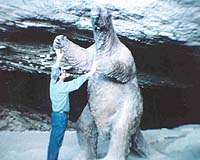
New Brunswick NJ (SPX) Sep 30, 2005 The first, high resolution continuous record of oxygen concentration in the earth's atmosphere shows that a sharp rise in oxygen about 50 million years ago gave mammals the evolutionary boost they needed to dominate the planet, according to Paul Falkowski, Rutgers professor of marine science and lead author of a paper published Sept. 30 in the journal Science. Falkowski and his colleagues have measured the abundance of carbon 13, a byproduct of photosynthesis, in deep-sea core samples that go back 205 million years. Because photosynthesis produces oxygen and leaves carbon 13 behind, the presence of carbon 13 in the fossil samples allows scientists to estimate precisely how much oxygen was in the atmosphere at any given time, Falkowski says. From a steady 10 percent - the level at which dinosaurs flourished - the oxygen percentage rose to 17 percent 50 million years ago and then to 23 percent by 40 million years ago. "In the fossil record, we see that see that this rise in oxygen content corresponds exactly to a really rapid rise of large, placental mammals," Falkowski says. "The more oxygen, the bigger the mammals. We argue that the rise in oxygen content allowed mammals to become very, very large - mammals like 12-foot-tall sloths and huge saber-toothed cats. They paved the way for all subsequent large mammals, including ourselves." The results described in Falkowski's article, "The Rise of Oxygen Over the Past 205 Million Years and the Evolution of Large Placental Mammals," stem from years of analysis of organic and inorganic core samples. Scientists have been using deep-sea core samples for years, but Falkowski and his colleagues have achieved greater precision in their measurements, thanks to two high-precision, isotope ratio mass spectrometers housed in the geological sciences department at Rutgers. There were placental mammals on Earth at the time of the great extinction of dinosaurs about 65 million years ago, Falkowski says. They were, however, tiny, limited creatures; the extinction event itself, while eliminating the dinosaurs, did little to further the mammalian domination of the planet. It was the subsequent spreading of shallow seas, the increase in plant life - and photosynthesis - in addition to the consequent increase in oxygen content that gave the mammals the boost they needed, according to Falkowski. In the last 10 million years, the percentage of oxygen in the earth's atmosphere has decreased to 21 percent. Falkowski says many scientists believed that great fires burned over the earth about 10 million years ago, reducing the number of trees and, therefore, the amount of photosynthesis and oxygen. Community Email This Article Comment On This Article Related Links SpaceDaily Search SpaceDaily Subscribe To SpaceDaily Express Darwin Today At TerraDaily.com
 Panda Paparrazi Swoons Over Cub Tai Shan At Washington Zoo
 Washington (AFP) Nov 29, 2005
There was 'panda-monium' at Washington's National Zoo on Tuesday as fluffy giant panda cub Tai Shan cavorted for the cameras, in his first encounter with the media pack. |
|
|

| The content herein, unless otherwise known to be public domain, are Copyright 1995-2006 - SpaceDaily.AFP and UPI Wire Stories are copyright Agence France-Presse and United Press International. ESA PortalReports are copyright European Space Agency. All NASA sourced material is public domain. Additionalcopyrights may apply in whole or part to other bona fide parties. Advertising does not imply endorsement,agreement or approval of any opinions, statements or information provided by SpaceDaily on any Web page published or hosted by SpaceDaily. Privacy Statement |