|
 |
 |
 |
 |
 |
 |
 |
 |

 |
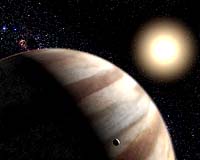
Oxygen And Carbon Found In Atmosphere Of An Extrasolar Planet
Baltimore - Feb 09, 2004 NASA's Hubble Space Telescope has detected, for the first time ever, the presence of oxygen and carbon in the atmosphere of a planet outside our solar system. The oxygen naturally exists and is not produced by any sort of life on the gaseous hot world, astronomers caution. Nevertheless, it is a promising demonstration that the chemical composition of atmospheres on planets many light-years away can be measured. This could someday lead to finding the atmospheric biomarkers of life on extrasolar planets. The oxygen and carbon are bleeding off the gas-giant extrasolar planet HD 209458b, orbiting a star lying 150 light-years from Earth. HD 209458b is only 4.3 million miles from its Sun-like star, completing an orbit in less than 4 days. It belongs to a class of planets called "hot Jupiters." Astronomers previously discovered that the upper atmosphere is so hot it boils hydrogen off into space. Astronomers used the Hubble Space Telescope Imaging Spectrograph to discover a rugby-ball shaped evaporating envelope of oxygen and carbon. Analysis of the starlight passing through the envelope shows it is being ripped off by the extreme "hydrodynamic drag" created by its evaporating hydrogen atmosphere. The planet has been dubbed "Osiris" after the Egyptian god that lost part of his body -- like HD 209458b -- after having been killed and cut into pieces by his brother to prevent his return to life. The planet HD 209458b is the first transiting planet discovered, the first extrasolar planet known to have an atmosphere, the first extrasolar planet observed to have an evaporating hydrogen atmosphere, and now the first extrasolar planet found to have an atmosphere containing oxygen and carbon. The Hubble team led by Alfred Vidal-Madjar (Institut d'Astrophysique de Paris, CNRS, France) is reporting this discovery in a forthcoming issue of Astrophysical Journal Letters. Community Email This Article Comment On This Article Related Links Space Telescope Science Institute, SpaceDaily Search SpaceDaily Subscribe To SpaceDaily Express Lands Beyond Beyond - extra solar planets - news and science Life Beyond Earth
 Study Highlights Role Of Hit-And-Run Collisions In Planet Formation
 Santa Cruz CA (SPX) Jan 12, 2006
Hit-and-run collisions between embryonic planets during a critical period in the early history of the Solar System may account for some previously unexplained properties of planets, asteroids, and meteorites, according to researchers at the University of California, Santa Cruz, who describe their findings in a paper to appear in the January 12 issue of the journal Nature.
--------------------------------------------------------- It's new. And it's downright terrific! Celestron's CPC Schmidt-Cassegrain telescope is the scope you've been waiting for! It offers new alignment technology, advanced engineering, and bold new design at a new, low price! In fact, Celestron's Professional Computerized (CPC) scope with revolutionary SkyAlign Alignment Technology redefines everything that amateur astronomers are looking for. It offers quick and simple alignment, GPS technology, unsurpassed optical quality, ease of use, advanced ergonomics, enhanced computerization and, most important, affordability. Want to view M-31 tonight? One button takes you there!
Shop for telescopes online at Telescopes.com! today!
|
|
|

| The content herein, unless otherwise known to be public domain, are Copyright 1995-2006 - SpaceDaily.AFP and UPI Wire Stories are copyright Agence France-Presse and United Press International. ESA PortalReports are copyright European Space Agency. All NASA sourced material is public domain. Additionalcopyrights may apply in whole or part to other bona fide parties. Advertising does not imply endorsement,agreement or approval of any opinions, statements or information provided by SpaceDaily on any Web page published or hosted by SpaceDaily. Privacy Statement |