|
 |
 |
 |
 |
 |
 |
 |
 |

 |
Overfishing Puts Southern California Kelp Forest Ecosystems At Risk
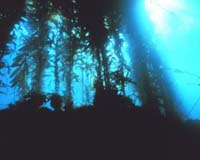
Santa Barbara CA (SPX) May 30, 2006 Kelp forest ecosystems that span the West Coast -- from Alaska to Mexico's Baja Peninsula -- are at greater risk from overfishing than from the effects of run-off from fertilizers or sewage on the shore, say scientists at the University of California, Santa Barbara. The findings have important implications for the design of California's Marine Protected Areas. In an article published in the May 26 issue of Science, scientists describe the first study to compare the top-down versus bottom-up human influences on the food chain of the kelp forest ecosystems. The study was conducted by scientists at UCSB's National Center for Ecological Analysis and Synthesis, known as NCEAS, which is funded by the National Science Foundation. "This study shows that California is on the right track by limiting fishing in certain areas in an effort to comply with the Marine Life Protection Act," said first author Ben Halpern, project director at NCEAS. Kelp are giant algae that reach up to 120 feet in height and support diverse ecosytems. They provide beautiful settings for scuba diving and are rich areas for commercial and recreational fishing. The research team took data from four years of marine life surveys by the National Park Service. The park service regularly checks 16 different kelp forest sites around the Channel Islands off the coast of Central California. They maintain data on 46 different species. Next, the scientists matched the park service data to data provided by SeaWiFs, a satellite monitoring project that photographs and analyzes ocean color for information about ocean life. This information can then be used to estimate nutrient levels in the ocean. Organic coastal run-off -- from fertilizers and sewage overflow -- increases the amount of organic material in the near shore ocean. According to the study, differences in the amount of organic material do not have much effect on the delicate food chain of the kelp forest ecosystem. However removal of the fish at the top of the food chain has a profound effect. When the predator species, such as rockfish, at the top of the food chain are removed, then the species that they normally eat, such as snails and barnacles, begin to increase in number. Many of these are herbivores that eat kelp. When their numbers increase, they decrease the amount of kelp, in turn changing how kelp forests look and the type of species that are associated with the kelp forest. "Kelp forests are so sensitive," said Halpern. "If you remove some of the predators, then you can have an effect on the entire kelp forest ecosystem." He explained that until now studies of kelp forests looked at either overfishing or increased nutrients. This is the first study to put both variables together to see which is more important. Community Email This Article Comment On This Article Related Links UCSB National Center for Ecological Analysis and Synthesis Darwin Today At TerraDaily.com
 Live Via Satellite Scientists To Track Caspian Sea Sturgeons
 Atyrau, Kazakhstan (SPX) May 26, 2006
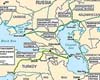
Scientists working in the Ural River, Kazakhstan, have successfully attached Pop-up Archival Transmitting (PAT) tags to four sturgeons and have released the animals into the Caspian Sea, hoping to get a clear picture of Caspian Sea sturgeon movement and behavior never before available. |
|
|

| The content herein, unless otherwise known to be public domain, are Copyright 1995-2006 - SpaceDaily.AFP and UPI Wire Stories are copyright Agence France-Presse and United Press International. ESA PortalReports are copyright European Space Agency. All NASA sourced material is public domain. Additionalcopyrights may apply in whole or part to other bona fide parties. Advertising does not imply endorsement,agreement or approval of any opinions, statements or information provided by SpaceDaily on any Web page published or hosted by SpaceDaily. Privacy Statement |