|
 |
 |
 |
 |
 |
 |
 |
 |

 |
Outta Here At Last
Stanford - Apr 26, 2004 Airborne at last! Forty-five years after its conception and 41 years after its initial funding, the Gravity Probe B (GP-B) experiment has finally launched. On April 20 at 9:57 a.m., a Boeing Delta II rocket sent the probe 400 miles high and into polar orbit from Vandenberg Air Force Base in Southern California. "This is a great moment and a great responsibility, the outcome of a unique collaboration of physicists and engineers to develop this near-perfect instrument to test Einstein's theory of gravity," said Stanford Research Professor Francis Everitt, co-principal investigator of the experiment with Professor Emeritus Brad Parkinson. "We are very grateful for all the support we have received at NASA and elsewhere for this exacting effort, truly a new venture in fundamental physics." A collaboration of Stanford, NASA and Lockheed Martin, the experiment will provide the most accurate test to date of Einstein's General Theory of Relativity. With a telescope aimed at a far-off guide star for reference, it will check tiny changes in the direction of spin of four gyroscopes, the roundest objects ever machined, spinning ping-pong balls of quartz coated with a superconductor and chilled near absolute zero with superfluid liquid helium, undisturbed by all forces save gravity. The gyroscopes precisely measure two effects predicted by Einstein. One, called frame dragging, posits that the revolving Earth drags time and space around with it like a spinning dancer's body causes her skirt to swirl. The other, the geodetic effect, says the Earth's mass warps local time and space like the weight of a bowling ball would dent a mattress. On April 19, 28 buses took about 1,000 onlookers -- GP-B staffers, their families and friends, and the press -- from the Marriott Hotel in Buellton, Calif., to a viewing area near the launch site. At Stanford, about 200 people packed Cubberley Auditorium to watch a NASA broadcast of the event. When the launch was scrubbed four minutes prior to liftoff due to high shear winds, a collective groan waved through Cubberley. A visitor at Vandenberg described the disappointment there as "palpable." The launch would be postponed by almost 24 hours. The next day, winds were kind. To cheers and applause, the 126.5-foot-long rocket lifted gently off the ground, first shedding six strapped-on solid rocket motors, later jettisoning three more. The probe started to line up with its guide star, I'm Pegasi, and began its duty of circling the Earth every 97.5 minutes. Then it deployed solar panels to capture the sun's energy to run various onboard electrical systems. "We have received initial data that indicates all systems are operating smoothly," said GP-B Program Manager Rex Geveden of NASA's Marshall Space Flight Center. After checking and calibrating instruments for about two months, researchers will collect scientific data for 12 months and perform additional calibrations for two more months. Controllers will be able to communicate with the orbiting spacecraft from the Mission Operations Center at Stanford. Then it will take scientists about a year to analyze all the data. As Everitt said at a NASA briefing in early April, "It's going to be a very dull experiment once it's got going."
Einstein for our grandchildren As of October 2003, the $700 million experiment had produced 78 doctorates in seven departments at Stanford and 16 at other universities, 15 master's or engineer's degrees, as well as research opportunities for about 300 undergraduates and 35 high school students. Much of the technology needed to put Einstein to the test had not yet been invented in 1959 when Leonard Schiff, head of Stanford's Physics Department, and George E. Pugh of the Defense Department independently proposed to observe the precession of a gyroscope in an Earth-orbiting satellite with respect to a distant star. Toward that end, Schiff teamed up with Stanford colleagues William Fairbank and Robert Cannon and subsequently, in 1962, recruited a 28-year-old Everitt, who is now 69. Decades of interdisciplinary collaboration between physicists and engineers turned their stardust dream into Earth-circling reality. But not everyone lived to see the launch. Schiff died in 1971, Fairbank in 1989. "The test of relativity is very simple, but the details are a testimony to perseverance," Parkinson said. That's because several parameters had to be held to zero to create a near-perfect science instrument, such as zero gravitational acceleration to create a drag-free environment. Micro-thrusters keep GP-B's space vehicle in perfect Earth orbit and alignment with the guide star by emitting gas puffs so small they're akin to about one-fiftieth of the breath you'd puff to clean your eyeglasses, he said. Gravity Probe B's collaborations have resulted in innovations including the SQUID (for Super Quantum Interference Device), to monitor spin axis orientation, and the world's most perfect gyroscopes, to measure angles so small they correspond to the width of a human hair as seen from a quarter of a mile away. They led to a new material to bond optical quartz and mechanical components so as not to interfere with the workings of the science instrument. They spawned a porous plug, since used in two other NASA missions, which allows helium to leave the cement-truck-sized thermos housing the experimental apparatus. They resulted in improved precision of a civilian Global Positioning System (GPS), now used to automate tractor plowings and aircraft landings. The experiment's greatest success may lie in its potential to bring new knowledge, such as greater understanding of black holes and warped space-time. In the 19th century, people probably wondered what good Maxwell's equations were, Parkinson said at the early-April NASA press briefing. But today useful evidence of his theories of electricity and magnetism are found in light bulbs, television, the Internet and more. Similarly, Parkinson said, new knowledge gained from Gravity Probe B may benefit our grandchildren more than ourselves. Stanford, under NASA contract, conceived the experiment and is responsible for the design and integration of the science instrument, as well as for mission operations and data analysis. Community Email This Article Comment On This Article Related Links Gravity Probe B SpaceDaily Search SpaceDaily Subscribe To SpaceDaily Express Space Technology News - Applications and Research
 Industry Team Achieve New Communications Technology With AESA Radars
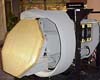 Baltimore MD (SPX) Jan 12, 2006
A team comprised of three leading US aerospace and defense contractors has demonstrated an innovative technological use of active electronically scanned array (AESA) radars for high-bandwidth communications. |
|
|

| The content herein, unless otherwise known to be public domain, are Copyright 1995-2006 - SpaceDaily.AFP and UPI Wire Stories are copyright Agence France-Presse and United Press International. ESA PortalReports are copyright European Space Agency. All NASA sourced material is public domain. Additionalcopyrights may apply in whole or part to other bona fide parties. Advertising does not imply endorsement,agreement or approval of any opinions, statements or information provided by SpaceDaily on any Web page published or hosted by SpaceDaily. Privacy Statement |