|
 |
 |
 |
 |
 |
 |
 |
 |

 |
Outside view: Russia May Run ISS Alone
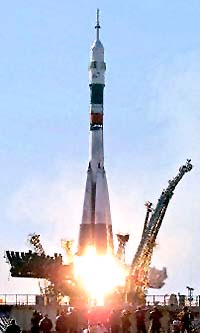
Moscow (UPI) Sep 26, 2005 Plagued by serious problems since its creation the International Space Station's situation seems almost tragic. The twelfth ISS expedition is due to lift off on Oct. 1. And one can safely say that the ISS program will never be the same again. This is also true of the entire system of international space cooperation. Only the Almighty knows what really lies ahead. True, puny mortals also have their say. The United States has now decided to abandon the ISS program. From now on, Russia is the only country that can keep the ISS in orbit. Those legendary U.S. Space Shuttles will be phased out completely by 2010. NASA plans to resupply the ISS with their help until then. However, the next shuttle launch deadline has not been set yet. N. Wayne Hale Jr., deputy manager of the Space Shuttle Program, told USA Today in early September that they could not launch a shuttle in March 2006; and the May 2006 deadline seemed unlikely. U.S. Space Shuttles may not lift off for nearly six months next year. Both Moscow and Washington have not yet decided on whether to use Russian spacecraft for flying in U.S. astronauts, or not. The Federal Space Agency (Roskosmos) is not required to launch its partners to the ISS after 2005. Purely commercial cooperation in line with bilateral agreements seems to be the only option nowadays. However, such agreements have not been signed to date. Moreover, Congress will not unanimously vote to finance the Federal Space Agency. In other words, the U.S. space program may remain grounded in the near future. Nor does NASA have any ideas about the exact number of its ISS missions until 2010. Twenty-eight shuttle flights were initially scheduled for the purpose of completing the ISS. But this goal seems far-fetched today. It would be nice to understand the logic of NASA bosses in Houston. But the ISS program's scenario seems illogical in this particular case. Otherwise we would have to admit that the United States is pinning high hopes on Russian spacecraft for subsequent low-orbit missions. Actually, this situation and some other aspects show that the United States does not really need the ISS. On Sept. 19, NASA administrator Michael Griffin unveiled plans for an advanced manned space vehicle that would replace the U.S. Space Shuttle, and that would fly U.S. astronauts to the Moon by 2018. NASA wants to organize inter-planetary expeditions alone. Anything else seems to be out of the question because the reusable Crew Exploration Vehicle (CEV) simply cannot dock with the ISS. Griffin himself admits that the U.S. space program will be grounded (until) after 2010, that is, until a CEV lifts off. The ISS would have to be mothballed by that time because it is impossible to complete the orbiter without space shuttles. The ISS will deplete its service life and cease to operate by 2015. Russia has no intention of renouncing the ISS program. Moreover, the Federal Space Agency drafted an action plan one year ago in connection with America's possible withdrawal. Nikolai Sevastyanov, general director of Russia's Energia Rocket & Space Corporation, is positive that Russia "will continue to sustain the ISS with the help of Soyuz and Progress spacecraft." "We will be launching more Soyuz spacecraft, as the Space Shuttle program withers on the vine. As I see it, up to four Soyuz vehicles will be launched toward the ISS per year by 2009," Sevastyanov said. This would be an impressive result, all the more so as Russia now sends aloft only two spacecraft each year. Commenting on the Federal Space Agency's recent proposals to assemble stand-by Soyuz and Progress spacecraft at the Baikonur space center, Sevastyanov said that Energia was "able to build additional spacecraft in conditions with normal financing." It sounds quite optimistic because the Russian government has agreed to set aside additional funds for the Federal Space Agency's new national space program that stipulates construction of the orbiter's Russian segment with the help of Russian money. (Andrei Kislyakov is a political commentator for the RIA Novosti news agency. This article is reprinted by permission of RIA Novosti.) (United Press International's "Outside View" commentaries are written by outside contributors who specialize in a variety of important issues. The views expressed do not necessarily reflect those of United Press International. In the interests of creating an open forum, original submissions are invited.) Community Email This Article Comment On This Article Related Links SpaceDaily Search SpaceDaily Subscribe To SpaceDaily Express Space Station News at Space-Travel.Com
 NASA Had No Choice But To Buy Soyuz Flights
 Washington DC (SPX) Jan 09, 2006
NASA's announcement last week that it will pay Roskosmos $43.6 million for a round-trip ride to the International Space Station this spring, and an equivalent figure for an as-yet-undetermined number of future flights to the station until 2012, represents the agency's acknowledgment that it had no alternative. |
|
|

| The content herein, unless otherwise known to be public domain, are Copyright 1995-2006 - SpaceDaily.AFP and UPI Wire Stories are copyright Agence France-Presse and United Press International. ESA PortalReports are copyright European Space Agency. All NASA sourced material is public domain. Additionalcopyrights may apply in whole or part to other bona fide parties. Advertising does not imply endorsement,agreement or approval of any opinions, statements or information provided by SpaceDaily on any Web page published or hosted by SpaceDaily. Privacy Statement |