|
 |
 |
 |
 |
 |
 |
 |
 |

 |
Outside View: U.S. Weapons In Space
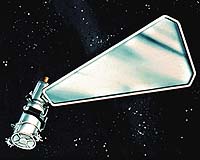
Moscow (UPI) May 1, 2005 Miracles only happen in fairy tales, not in the high-tech world, which lives according to its own logic. In mid-April, Lt. Gen. Henry Obering, the director of the U.S. Missile Defense Agency, addressed the third Annual Missile Defense Conference in Washington, where he said new global threats highlighted the need to create space-based defensive systems. So, though there are no weapons in space today, they may well be there tomorrow. In particular, this means orbital interceptors, which, in Obering's opinion, should become part of America's ballistic missile defense program. Moscow expected Obering to say something like this, but was never likely to term it good news. "The deployment of anti-ballistic missile systems' information-reconnaissance and strike elements in space will reduce the threshold of global military danger," Vladimir Belous, leading research associate at the World Economy and International Relations Institute, said. "And an arms race will begin in space." Although President Bush recently said orbital weapons would not be deployed, the opposite seems inevitable, which is the main danger of the national missile defense program. Indeed, its "eyes" and "ears" (the information-reconnaissance infrastructure) that will be deployed on space vehicles must be given the appropriate protection. Bush assured Canada's premier in Ottawa last year his administration did not intend to deploy orbital weapons. However, it is worth repeating: miracles do not happen in the defense-technology world. First, any new invention requires adequate protection. Second, a more effective counter technology will always emerge. By introducing allegedly useful defense technologies, mankind could gradually lose control over its own achievements. There is a solution to this predicament. Alexei Arbatov, a leading Russian authority on strategic arms, said April 19 U.S. military security depended on the normal operation of auxiliary space systems like no other country. "Naturally, the United States does not want countries such as Russia, China and some others to develop anti-satellite weapons," Arbatov said. Arbatov said attempts cold be made to try to convince Washington it would be better to ensure spacecraft safety on the basis of various accords and international-law restrictions than to deploy anti-satellite weapons for shielding these systems. "Russia will have to modify its policy of the last few years and start producing more initiatives. This could rid us of a new threat that could be a serious problem for Russia: the deployment of attack weapons in space," he said. Moscow has already put forward this initiative. The Russian delegation told the First Committee of the 59th U.N. General Assembly last October it would not deploy any space weapons. This unilateral Russian initiative did not come with any preconditions attached, while Russia also called on all other space powers to follow its example. If the Russian initiative is supported, then unilateral military superiority in space will remain non-science fiction. Andrei Kislyakov is a political commentator for the RIA Novosti news agency. This article is reprinted by permission of RIA Novosti. United Press International's "Outside View" commentaries are written by outside contributors who specialize in a variety of important issues. The views expressed do not necessarily reflect those of United Press International. In the interests of creating an open forum, original submissions are invited. Community Email This Article Comment On This Article Related Links SpaceDaily Search SpaceDaily Subscribe To SpaceDaily Express Military Space News at SpaceWar.com
 Space Group To Activate New Unit
 Colorado Springs CO (SPX) Jan 6, 2006
Air Force Reserve Command's 310th Space Group will travel deeper into the space program when it activates a new unit Jan. 7. Headquarters Reserve National Security Space Institute will be a Reserve associate unit to the National Security Space Institute in Colorado Springs, Colo. The institute is the Department of Defense's focal point for providing education about space power in joint warfighting. |
|
|

| The content herein, unless otherwise known to be public domain, are Copyright 1995-2006 - SpaceDaily.AFP and UPI Wire Stories are copyright Agence France-Presse and United Press International. ESA PortalReports are copyright European Space Agency. All NASA sourced material is public domain. Additionalcopyrights may apply in whole or part to other bona fide parties. Advertising does not imply endorsement,agreement or approval of any opinions, statements or information provided by SpaceDaily on any Web page published or hosted by SpaceDaily. Privacy Statement |