|
 |
 |
 |
 |
 |
 |
 |
 |

 |
Outside View US No Better Than Soviets
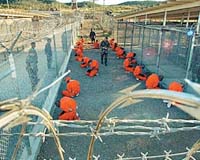
UPI Outside View Commentator Washington DC (UPI) Feb 22, 2006 Now that the Defense Department has come up with a name for the current conflict -- "the Long War" -- it's fair to ask if that war's duration amounts to a life sentence for detainees and also to question the circumstances under which captives are being held. I never bought the argument that those captured in Afghanistan or elsewhere do not deserve Prisoner of War status because they are not members of the armed forces of a recognized government. A war is a war, and a prisoner is a human being regardless of whether his side has a parliament or an air force. In the past, civilized countries repatriated POWs after the cessation of hostilities. Prisoners taken in the fall of 2001 have now been held almost four-and-a-half years, longer than the United States was a belligerent in World War II. At a time when it's not uncommon for convicted murderers to serve 15 years or less in some Western democracies, how long should somebody be incarcerated for running with the wrong crowd in Jalalabad? Don't get me wrong. Anyone who continues to present a danger should be kept locked up in Guantanamo, and I'm not competent to sort the prisoners out. But clearly, not everyone who was scooped up in Afghanistan was a threat. Let's stipulate, however, that everyone who should be repatriated has already been sent to his home country. For the sake of argument, assume only the hard cases remain. This does not justify the brutal force-feeding of hunger strikers who have no other way to protest their indefinite incarceration. In a Feb. 9 report, The New York Times' Tim Golden quotes Lt. Col. Jeremy M. Martin, chief military spokesman at Guantanamo, as saying the force-feeding has been carried out "in a humane and compassionate manner" and only when necessary to keep the prisoners alive. But Golden also cites military officials who say detainees have been strapped into restraint chairs, sometimes for hours a day, to be force-fed through tubes inserted through the nose. Through attorneys, prisoners describe rough treatment, with feeding tubes inserted and removed so violently that some detainees bled, fainted, or screamed in pain. It scarcely needs to be said that the hunger strike has been used by such respected figures as Mohandas K. Gandhi, British suffragettes of the early 20th century, and prisoners of conscience in the former Soviet Union. As for the "humane and compassionate" nature of force-feeding through nasal tubes, we have the account of Vladimir Bukovsky, who warns not only against the inhumanity of such measures, but also against the corrosive effect it has on its perpetrators. How can you compel your own people to commit acts that will scar them forever? Bukovsky asked in Dec. 18 Washington Post essay. He made his case by recounting how he was force-fed through the nostrils in Moscow's notorious Lefortovo Prison in 1971. "About a dozen guards led me from my cell to the medical unit," Bukovsky wrote. "There they straitjacketed me, tied me to a bed, and sat on my legs so that I would not jerk. The others held my shoulders and my head while a doctor was pushing a feeding tube into my nostril. "The feeding pipe was thick, thicker than my nostril, and would not go in. Blood came gushing out of my nose and tears down my cheeks, but they kept pushing until the cartilages cracked. I guess I would have screamed if I could, but I could not with the pipe in my throat. I could breathe neither in nor out at first; I wheezed like a drowning man -- my lungs felt ready to burst. The doctor also seemed ready to burst into tears, but she kept shoving the pipe father and farther down. Only when it reached my stomach could I resume breathing, carefully. Then she poured some slop through a funnel into the pipe that would choke me if it came back up. They held me down for another half-hour so that the liquid was absorbed by my stomach and could not be vomited back, and then began to pull the pipe out bit by bit." The procedure was repeated every morning for ten days, when the guards could stand it no longer. "As it happened it was a Sunday and no bosses were around. They surrounded the doctor: 'Hey listen, let him drink it straight from the bowl, let him sip it. It'll be quicker for you, too, you silly old fool.' The doctor was in tears: 'Do you think I want to go to jail because of you lot?' ... And so they stood over my body, cursing each other, with bloody bubbles coming out of my nose." On the twelfth day, the authorities acceded to Bukovsky's demand: he could get his own lawyer instead of one assigned by the KGB. "But neither the doctor nor those guards could ever look me in the eye again," Bukovsky wrote. Do U.S. staffers at Guantanamo have less humanity than the guards at Lefortovo -- despised Soviet apparatchiks? Bukovsky, whose case horrifies even in retrospect, was hunger-striking for his own attorney. The Guantanamo prisoners, faced with life sentences without trial, have greater cause. U.S. officials justify the force-feeding as suicide prevention. In fact, they are cruelly removing the prisoners' one method of non-violent protest against an intolerable situation.
Source: United Press International Community Email This Article Comment On This Article Related Links - Read the latest in Military Space Communications Technology at SpaceWar.com
 USJFCOM And NGA Working To Enhance Geospatial Intelligence
 Norfolk VA (SPX) Feb 22, 2006
U.S. Joint Forces Command (USJFCOM) and National Geospatial Intelligence Agency (NGA) have agreed to move forward on a joint geospatial intelligence activity (JGA) to enhance geospatial intelligence (GEOINT) among national and tactical users. |
|
|

| The content herein, unless otherwise known to be public domain, are Copyright 1995-2006 - SpaceDaily.AFP and UPI Wire Stories are copyright Agence France-Presse and United Press International. ESA PortalReports are copyright European Space Agency. All NASA sourced material is public domain. Additionalcopyrights may apply in whole or part to other bona fide parties. Advertising does not imply endorsement,agreement or approval of any opinions, statements or information provided by SpaceDaily on any Web page published or hosted by SpaceDaily. Privacy Statement |