|
 |
 |
 |
 |
 |
 |
 |
 |

 |
Outside View: Tehran opts for the hard way
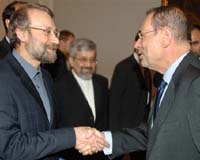
Moscow (UPI) Oct 29, 2007 Tehran's tough new stance in its dialogue with the U.N. Security Council over its nuclear program, heralded by the sudden resignation of Ali Larijani as chief negotiator earlier this month, is the product of generational shift in Iran's political elite. Larijani was head of Iran's Supreme National Security Council. Changing negotiators at a crucial moment is a bad policy, but Iran is changing more than personnel; it is changing its policy, along with its political elite. The old guard -- the ayatollahs led by the country's spiritual leader, Ali Khamenei -- is gradually ceding positions to a new generation of neoconservatives, also described as "the second wave of Islamic revolutionaries." President Mahmoud Ahmadinejad is the appointed leader of the neoconservatives, whose goal is to prevent the liberalization of Islamic standards in the social, political and economic spheres. Ahmadinejad's victory in the presidential election of August 2005 was secured by the ayatollahs, who control various Islamic funds. The funds are the richest, and hence the most influential, organizations in Iran. But the clerics do not have an economic or social program and advocate building "a truly Islamic, just society" based on the achievements of the 1979 Islamic revolution. The ayatollahs' populist slogans have provoked social and economic conflicts in the country. In May 2006, leading Iranian economists warned the Ahmadinejad government that the situation was rapidly deteriorating. Iran's biggest problems today are inflation and unemployment, as well as the growing crisis in the oil and gas sectors, which can ruin the national economy. Experts have calculated that oil export revenues, which account for 80 percent of Iran's total export income, will decline by 10 percent to 12 percent a year, all the way to zero by 2015. The oil and gas sector badly needs foreign investment, which Tehran can get only if it changes its policy. The country has two options: either use populist slogans to consolidate the nation, or change the policy or the regime. The Ahmadinejad government is favoring the former option. Larijani, who had to smooth over the sharp statements by Ahmadinejad and Khamenei at meetings with the Iranian Six and Mohammed ElBaradei, head of the International Atomic Energy Agency, does not suit it. It is indicative that Larijani resigned shortly before a meeting with the EU foreign policy chief, Javier Solana. Seen by many as a smart diplomat who can find a way out of blind alleys, Solana apparently liked the Iranian negotiator. Larijani's resignation is the second important event in Iran this year, and the more shocking of the two. The first was the replacement of the Islamic Revolution Guards' commander, who was a Khamenei man, with an appointee of Ahmadinejad. In Iran, the president stands one rank below the spiritual leader. Such high-level changes are not made for personal reasons, as Tehran is trying to convince the world in the case of Larijani. They point to a change of policy, or a tougher stance. Ahmadinejad most probably received the go-ahead from Khamenei to speed up the development of uranium enrichment technologies and to carry on the old domestic and foreign policy. This is not surprising, because the problem of a successor in the Iranian political establishment has grown acute of late. (Pyotr Goncharov is a political commentator for RIA Novosti, by whom an earlier version of this article was published. The opinions expressed in this article are the author's and do not necessarily represent those of RIA Novosti.) (United Press International's "Outside View" commentaries are written by outside contributors who specialize in a variety of important issues. The views expressed do not necessarily reflect those of United Press International. In the interests of creating an open forum, original submissions are invited.) Community Email This Article Comment On This Article Related Links Learn about nuclear weapons doctrine and defense at SpaceWar.com Learn about missile defense at SpaceWar.com All about missiles at SpaceWar.com Learn about the Superpowers of the 21st Century at SpaceWar.com
 Six nations resume talks on energy aid for NKorea
 Seoul (AFP) Oct 29, 2007
A ship with heavy fuel oil provided by the United States was headed to North Korea Monday as nations involved in disarmament talks resumed talks on energy aid for the communist country. |
|
|

| The content herein, unless otherwise known to be public domain, are Copyright 1995-2007 - SpaceDaily.AFP and UPI Wire Stories are copyright Agence France-Presse and United Press International. ESA Portal Reports are copyright European Space Agency. All NASA sourced material is public domain. Additional copyrights may apply in whole or part to other bona fide parties. Advertising does not imply endorsement,agreement or approval of any opinions, statements or information provided by SpaceDaily on any Web page published or hosted by SpaceDaily. Privacy Statement |