|
 |
 |
 |
 |
 |
 |
 |
 |

 |
Outside View: Su-34 strategy -- Part 2
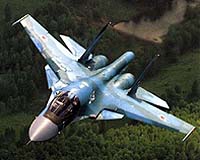
Moscow, April 23, 2008 The Sukhoi Su-34 Fullback aircraft's remarkable qualities give Russia the option of using a relatively small number of them as an elite strike force. This is not a new concept. Elite units of top-class aircraft manned by superbly trained crews formed the core of the German air force, the Luftwaffe, during World War II, and Japan's Imperial Navy had a similar concept. However, such elite units can be quickly weeded out by swarms of ordinary aircraft in a global war of attrition, such as World War II. From this viewpoint, Russia's new concept looks vulnerable, but then this country has the nuclear triad for a global war. In a war of attrition, it will not matter how many such smart aircraft Russia will have -- 200, 600 or 1,500. What will matter is the yield of a nuclear bomb they will be able to drop on the enemy. But in the event of a small war involving one or two adversaries, or a chain of local conflicts, the existence of such high-speed, highly protected and well-armed aircraft can be the decisive factor. Even 58 Sukhoi Su-34 Fullback fighter-bombers, used at the right time in the right place, would be a powerful force. A group of 200-300 such aircraft, divided into several units for use in key areas of the battlefield, will be able to complete the most complicated tasks. Apart from the Sukhoi Su-34 Fullback, the Russian air force will also receive other new planes, whose technical characteristics will maintain the force's combat potential at the requisite level. New units, set up for the fulfillment of specific tasks, will consist of fighters, bombers, early warning and command planes, flying tankers and unmanned aerial vehicles. These forces will be highly mobile units, which means aircraft can be quickly dispatched to the area in question. In fact, Russia's new concept is not unlike the U.S. Aerospace Expeditionary Force, a flexible and powerful instrument of air warfare capable of quickly delivering strikes in any part of the world. As for surveillance aircraft, industrialized countries intend to replace them with unmanned aerial vehicles. The world is changing, and the new world will wage new kind of wars. (Ilya Kramnik is a political commentator for RIA Novosti. This article is reprinted by permission of RIA Novosti. The opinions expressed in this article are the author's and do not necessarily represent those of RIA Novosti.)
Email This Article Comment On This Article Related Links The latest in Military Technology for the 21st century at SpaceWar.com
 Outside View: Su-34 strategy -- Part 1
 Moscow, April 22, 2008
 Russia's rearmament program, approved in 2006 for a period until 2015, provides for supplying modern weapons to its armed forces. One of them is the Sukhoi Su-34 Fullback fighter-bomber, which will replace the Sukhoi Su-24 Fencers. (United Press International's "Outside View" commentaries are written by outside contributors who specialize in a variety of important issues. The views expressed do not necessarily reflect those of United Press International. In the interests of creating an open forum, original submissions are invited.) |
|
|

| The content herein, unless otherwise known to be public domain, are Copyright 1995-2007 - SpaceDaily.AFP and UPI Wire Stories are copyright Agence France-Presse and United Press International. ESA Portal Reports are copyright European Space Agency. All NASA sourced material is public domain. Additional copyrights may apply in whole or part to other bona fide parties. Advertising does not imply endorsement,agreement or approval of any opinions, statements or information provided by SpaceDaily on any Web page published or hosted by SpaceDaily. Privacy Statement |