|
 |
 |
 |
 |
 |
 |
 |
 |

 |
Outside View: Russia's copter challenge
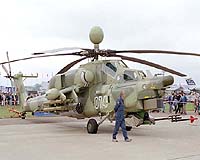
Moscow (UPI) Aug 22, 2007 On Aug. 21, an international aerospace show opened in Zhukovsky outside Moscow. Its third day has been declared the Day of Russian Helicopters. The increased interest in this sector of the Russian aircraft industry is not accidental. In mid-August, Russian President Vladimir Putin noted that helicopter building was one of the main challenges facing Russian aviation. In 2006, 93 helicopters were produced in Russia, according to Industry Ministry figures. Compared with 2005, when 80 helicopters were manufactured, the rise in output was 16 percent. But this increase was mainly due to export orders. That demand, in turn, was fueled not so much by the high quality of Russian products as by their relatively low price compared with foreign models. The program to integrate engine-building companies into a single whole has never been realized, because rigid administration in such a high-tech sector as aircraft engine building could not be effective. But market pressures have forced Russian companies to join forces to compete with such overseas giants as General Electric, Pratt and Whitney, Rolls Royce and Snecma. It appears that the differing ownership structures of these companies had little influence on the process of cooperation. The state-owned Salyut firm is one of the most successful in the industry today. It has brought many related enterprises together and set up a design bureau. Moreover, it has managed to restore its workforce, which dropped to one-sixth in the early 1990s. NPO Saturn is also going strong, and has also set up a design bureau. Another example of effective cooperation is a joint venture established on the basis of Russia's Klimov Corp. and Ukraine's Motor Sich. The creation of the United Aircraft Building Corp. hastened integration in the aero engine sector. But, having become a monopoly, Russian aircraft builders want to keep competition alive among their subcontractors. In their opinion, there must be no fewer than two engine-building companies in Russia. "Second-tier" competition, they argue, will enable them to produce better quality products and avoid a cartel dictating prices. This attitude seems to have met with understanding among the nation's leadership. The government decided to set up not two, but four aero engine holdings. Russian President Vladimir Putin has already signed the decree to establish one of them on the basis of Salyut. Proposals have been approved to set up another three of them: on the basis of Klimov; from plants of the Samara Aircraft Building Center; and by consolidating government holdings in engine plants in Perm, Rybinsk and Ufa. Also signed is a decree to establish a helicopter-building holding, which was already a reality but did not include two large companies -- one in Kumertau and one in the Far East called Progress. Now they too will be incorporated into a single helicopter corporation, in which the "head," or the design bureau, will not be separated from the "body," or mass-production plants. The main snag for the new helicopter-building holding, at least at an early stage, will be engines, because their production in Russia is limited. The present-day view is that the engine accounts for 50 percent of the efficiency of a modern flying machine. Currently, Ukraine's Motor Sich mass produces the VK-2500 engine, which Russia's Defense Ministry intends to install on the Mi-28N Night Hunter and Ka-52 Hokum attack helicopters, and on military transport helicopters of the Ka and Mi families. This 2,400 hp engine is a further development of the popular TV3-117VMA engine used in Hinds and other military helicopters. The VK-2500 differs from it by having a digital fly-by-wire control system and a new design of compressor turbine. The engines were only developed in Russia, and were mass produced in Ukraine. The developer, the Klimov Corp., first produced only small numbers using Ukrainian components. But, starting in 1996, Russia adopted a policy of building helicopters by itself, without foreign partners. Ahead of the opening of the Engines-2006 international exhibition last year, documents were signed to give the go-ahead to the production of the VK-2500 at the Chernyshev plant in Moscow. Early deliveries of Moscow-assembled engines are scheduled for 2009. Meanwhile, production of a helicopter engine of a new generation, the VK-800, is being planned for Moscow. Single-handed, even the Klimov Corp. could not supply all the engines needed by helicopter-building firms. The Defense Industry Commission has therefore recommended organizing large-scale production of the VK-2500 and VK-800 at the Ufa Motor Plant. Preliminary costs for the production of the VK-2500 are estimated at $150 million to $200 million. (Yury Zaitsev is an academic adviser at the Academy of Engineering Sciences. This article is reprinted by permission of RIA Novosti. The opinions expressed in this article are the author's and do not necessarily represent those of RIA Novosti.) (United Press International's "Outside View" commentaries are written by outside contributors who specialize in a variety of important issues. The views expressed do not necessarily reflect those of United Press International. In the interests of creating an open forum, original submissions are invited.) Community Email This Article Comment On This Article Related Links The latest in Military Technology for the 21st century at SpaceWar.com
 Putin shows off Russia's military aviation
 Zhukovsky, Russia (AFP) Aug 21, 2007
Russian President Vladimir Putin on Tuesday praised Russia's military aviation at an airshow outside Moscow as Indonesia prepared to sign a major contract for the purchase of Russian fighter jets. |
|
|

| The content herein, unless otherwise known to be public domain, are Copyright 1995-2007 - SpaceDaily.AFP and UPI Wire Stories are copyright Agence France-Presse and United Press International. ESA Portal Reports are copyright European Space Agency. All NASA sourced material is public domain. Additional copyrights may apply in whole or part to other bona fide parties. Advertising does not imply endorsement,agreement or approval of any opinions, statements or information provided by SpaceDaily on any Web page published or hosted by SpaceDaily. Privacy Statement |