|
 |
 |
 |
 |
 |
 |
 |
 |

 |
Outside View: Russia Mediates Iran Nukes
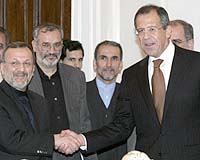
Moscow (UPI) Oct 26, 2005 The recent visit to Moscow by Iranian Foreign Minister Manuchehr Mottaki has failed to elucidate whether or not Tehran will accept International Atomic Energy Agency recommendations to extend its moratorium on uranium enrichment. Iran may refuse IAEA inspections if its nuclear program is referred to the U.N. Security Council, Mottaki told reporters after meeting Russia's Foreign Minister Sergei Lavrov. "If Iran's nuclear file is referred to the Security Council, Iran may discontinue observing the additional protocol to the Nuclear Non-Proliferation Treaty," Mottaki said. Moscow is trying to keep Iran from doing this. Iran's intention during this one-day visit to Moscow was most likely to secure Russia's support at the forthcoming session of the IAEA board of governors concerning the Iranian nuclear program. About a month ago the board passed a resolution by the Eurotroika of Britain, France and Germany to refer the Iranian nuclear file to the United Nations Security Council with the prospect of introducing international sanctions against Tehran. The document demanded that before the IAEA board meets in November Iran should resume its moratorium on nuclear activity and give up efforts to develop a full nuclear cycle. Iran called the resolution "unacceptable" and said that if the board failed to amend the document Tehran would "stick to its position." The resolution was harshly worded, and the conflict threatened to escalate. Denunciation of all earlier commitments, including the additional protocol, meant IAEA inspectors would be barred any access to Iranian nuclear facilities. This would allow the United States as Tehran's main opponent to claim that Iran is on the threshold of creating nuclear weapons. Washington has already "cut back" Iran's lead time to develop such weapons from five or seven years, as the majority of international experts believe, to two years. Moscow has a special role in resolving the Iranian nuclear issue. On the one hand, Russia, cooperating with Iran in nuclear matters, has some leverage on Tehran and, on the other, as a permanent U.N. member it can use its power of veto to stop any Security Council decision. Both Iran and the U.S. are aware of these two factors. As a result, Tehran and Washington stepped up their diplomatic efforts in the Russian capital. Early in October, Secretary of State Condoleezza Rice paid a sudden visit to Moscow, with the Iranian nuclear issue high on her agenda. Now the Iranian foreign minister arrived in Moscow at the same time as National Security Adviser Steven Hadley. Washington is making no secret of its intention to persuade Moscow to toughen its stand on Iran. In September, Tehran secured Moscow's backing both at the U.N. General Assembly and at the IAEA board of governors' meeting. At the meeting, Russia and China voted against submitting the Iranian nuclear file to the U.N. Security Council. The Eurotroika and the board were forced to omit mentioning the referral deadlines. How do things stand now? Moscow has repeatedly said lately that it is going to adhere to the IAEA position. "While Iran cooperates with it and maintains its moratorium on uranium enrichment and IAEA inspectors are allowed to see Iranian facilities, it is non-constructive to refer the file to the U.N. Security Council," Sergei Lavrov said earlier, explaining Russia's position. He confirmed it after meeting Mottaki. Russia, he said, believes in "continuing the efforts through the IAEA." Judging from what Mottaki told journalists, this stand by Moscow came as a bit of surprise for Tehran. The next time the board is going to meet is Nov. 24. By that deadline Tehran is to decide if it accepts IAEA terms and desists from developing its own nuclear fuel cycle, or faces the prospect of its nuclear file being referred to the U.N. Security Council, with the inevitable international sanctions. Igor Ivanov, head of Russia's Security Council, is planning to visit Iran in the next two to three weeks. It may be the last Moscow's attempt to persuade Tehran to accede to the IAEA recommendations. Pyotr Goncharov is a political commentator for the RIA Novosti news agency. This article is reprinted by permission of RIA Novosti. United Press International's "Outside View" commentaries are written by outside contributors who specialize in a variety of important issues. The views expressed do not necessarily reflect those of United Press International. In the interests of creating an open forum, original submissions are invited. Community Email This Article Comment On This Article Related Links SpaceDaily Search SpaceDaily Subscribe To SpaceDaily Express Learn about nuclear weapons doctrine and defense at SpaceWar.com Learn about missile defense at SpaceWar.com All about missiles at SpaceWar.com Learn about the Superpowers of the 21st Century at SpaceWar.com
 Iran Nuclear Row Coming To A Head Says US Official
 Washington (AFP) Jan 11, 2006
The United States said Wednesday the row over Iran's suspected nuclear arms program was quickly coming to a head and was increasingly likely to end up before the UN Security Council. |
|
|

| The content herein, unless otherwise known to be public domain, are Copyright 1995-2006 - SpaceDaily.AFP and UPI Wire Stories are copyright Agence France-Presse and United Press International. ESA PortalReports are copyright European Space Agency. All NASA sourced material is public domain. Additionalcopyrights may apply in whole or part to other bona fide parties. Advertising does not imply endorsement,agreement or approval of any opinions, statements or information provided by SpaceDaily on any Web page published or hosted by SpaceDaily. Privacy Statement |