|
 |
 |
 |
 |
 |
 |
 |
 |

 |
Outside View: Responses To Terror
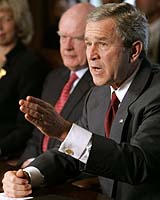
Washington (UPI) Oct 27, 2005 President George W. Bush asserts that fighting in Iraq is a necessary correction to the responses by the Carter, Reagan, and Clinton administrations to earlier terrorist challenges. "To leave Iraq now," the president argues, "would be to repeat the costly mistakes of the past that led to the attacks of Sept. 11, 2001 ... the terrorists concluded that we lacked the courage and character to defend ourselves, and so they attacked us." However, this "mistakes of the past" thesis ignores the historical context and differing circumstances of previous decisions. It portrays the complex evolution of terrorism over several decades as a straight line of causation -- like falling dominos -- from events in the 1970s to the terrorist attacks of 9/11. It reduces diverse conflicts, tactics, and adversaries to a single set of adversaries -- "the terrorists." Presidents make life and death decisions about the use of military force where many factors count. Will it achieve the desired goal? Will the costs be acceptable? Will the American public support it? Will it risk more dangerous consequences? Will it, in the long run, serve national interests? Debate over the use of military force in response to terrorism, in fact, goes back to the Nixon administration. When American citizens, among several hundred passengers, were held hostage in Jordan by terrorist hijackers in 1970, President Richard M. Nixon contemplated sending in troops to end the standoff, but the situation in the Middle East was complex and dangerous, even more so with a war in Vietnam and the Soviet Union just over the horizon. Instead, the administration pursued a negotiating strategy, the hostages were released, and the crisis was defused. It is not clear that effecting the release of American hostages held in Tehran in 1980 would have been served by naval blockade, mining Iran's harbors, bombing or other military options. Already in confrontation with the Soviet Union over its invasion of Afghanistan, the United States could have found itself at war in Iran, for which there was little political support just five years after the fall of South Vietnam, and the hostages almost certainly would have been killed. As it was, the attempted rescue ordered by President Jimmy Carter was the first use of military force after the Vietnam War. A high-risk operation, it failed. President Ronald Reagan entered office warning that military force could be used in response to terrorism, despite strong opposition from the Pentagon. Following the bombing of the Marine barracks in Lebanon in 1983, he initially authorized retaliatory air strikes, although he said later that he changed his mind at the last minute; a smaller air strike did take place. It is not clear what larger scale bombing would have achieved, but the withdrawal of American forces four months later suggested that terrorists could influence U.S. policy. The United States, however, already had gone beyond its original mission of protecting the withdrawal of the Palestine Liberation Organization from Beirut. Remaining in Lebanon ran the risk of becoming further enmeshed in that country's bloody civil war. Responding to a Libyan-sponsored terrorist campaign, President Reagan in 1986 ordered the bombing of targets in Libya, including Qadhafi's residence. As his Secretary of State, George Shultz declared, the United States was no longer going to "take terrorist punches." President Bill Clinton ordered the bombing of Iraq in 1993 in response to suspected Iraqi involvement in an attempted assassination of former President George Herbert Walker Bush during a trip to Kuwait. Iraq was already under economic sanctions and no-fly zones were in effect in both the northern and southern parts of the country. Short of invasion and regime removal, there were not a lot of military options. In 1998, President Clinton ordered cruise missiles to be fired at targets in Sudan and Afghanistan in response to the bombings of American embassies in Africa. Intelligence indicated that a missile strike might wipe out a substantial portion of al-Qaida's top leadership. The missiles missed Osama bin Laden. There was no political support for the invasion of Afghanistan, and Pentagon planners offered few other options. Perhaps understandably the current President Bush omits the presidency of his father from his broadside. Yet it was the first Bush administration that rejected military action against Libya, despite clear evidence of Libyan involvement in the 1988 sabotage of Pan Am 103 -- the worst terrorist incident suffered by the United States prior to Sept. 11, 2001. Instead, the president decided to proceed with individual criminal indictments against the Libyan officials involved, thus keeping the U.S. response to terrorism firmly in the realm of law enforcement. And it was the elder Bush who in 1991 decided not to go beyond the original objective of liberating Kuwait in the first Gulf War, leaving Saddam Hussein in power. What these decisions show is a growing willingness to use military force as terrorism escalated over a period of several decades, but a clear desire to avoid exacerbating crises or expanding conflicts. The military themselves were often the most reluctant participants. They provided few attractive options. Sometimes, military force failed. Each decision must be seen in the context of the situation at the time. If they were "costly mistakes," it is fair to ask what President Bush would have done in each case. Would he have invaded Iran in 1980, sent more troops into Lebanon in 1983 to join a sectarian civil war, effected regime change in Libya in 1986, or in 1989, gone all the way to Baghdad in 1991? Where would he have used military force after apprehending the first World Trade Center bombers in 1993? Those who employ terrorist tactics observe and learn from one another. Successes are imitated. Tactics evolve. Terrorism has a history. But it goes too far to connect these events in a single file. The Iranian revolutionaries who seized the American embassy sought confrontation with the "Great Satan." Less than three years after the bombing of Tripoli, Libyans sabotaged Pan Am 103. There is no evidence that plotters behind the 1993 World Trade Center bombing were emboldened by President Carter's or President Reagan's costly mistakes. True, Osama bin Laden inspired followers by pointing to American withdrawals from Lebanon and Somalia as evidence that America is a paper tiger, but it was the Soviet Union's retreat from Afghanistan that puffed up his reputation, and it was the presence of U.S. military forces in Saudi Arabia as an example of what he saw as continuing infidel aggression that prompted his declaration of war. Abu Musab al-Zarqawi was nobody until the insurgency in Iraq propelled him to notoriety -- his goal is Armageddon. There are terrorists -- those who employ terrorist tactics, but there is no such thing as the terrorists -- some perennial gang of bad guys who ride from town to town terrorizing citizens until someone guns them down. There simply is no straight line that takes us from Jordan in 1970 to Iran in 1980 to September 11, 2001 to Baghdad in 2005. As a presidential candidate, George W. Bush himself argued for a judicious use of military force. He did not enter the Oval Office looking for military options in response to the bombing of the USS Cole three months before. Instead, he focused on issues he thought to be of greater strategic importance. Events altered his priorities. We cannot view previous decisions through the smoke and rubble of Sept. 11, 2001, which made military action obvious and imperative. Military action comparable to that in Afghanistan or Iraq would have been just as inappropriate in these earlier cases as the absence of a muscular riposte would have been after Sept. 11, 2001. And while military action may create new realities, it does not always do so in ways that are predictable or desirable -- it is a lesson we are learning in Iraq. (Brian Michael Jenkins is a terrorism expert and senior adviser to the president of the RAND Corp., a non-profit research organization.) (United Press International's "Outside View" commentaries are written by outside contributors who specialize in a variety of important issues. The views expressed do not necessarily reflect those of United Press International. In the interests of creating an open forum, original submissions are invited.) Community Email This Article Comment On This Article Related Links SpaceDaily Search SpaceDaily Subscribe To SpaceDaily Express The Long War - Doctrine and Application
 SAIC to Provide Bio-Surveillance Software, Data Analysis for Centers for Disease Control
 Atlanta GA (SPX) Dec 09, 2005
Science Applications International Corporation (SAIC) announced Thursday it was awarded two contracts in support of the Centers for Disease Control and Prevention (CDC) National Center for Public Health Informatics' BioSense program. |
|
|

| The content herein, unless otherwise known to be public domain, are Copyright 1995-2006 - SpaceDaily.AFP and UPI Wire Stories are copyright Agence France-Presse and United Press International. ESA PortalReports are copyright European Space Agency. All NASA sourced material is public domain. Additionalcopyrights may apply in whole or part to other bona fide parties. Advertising does not imply endorsement,agreement or approval of any opinions, statements or information provided by SpaceDaily on any Web page published or hosted by SpaceDaily. Privacy Statement |