|
 |
 |
 |
 |
 |
 |
 |
 |

 |
Outside View: Challenge of a larger Europe
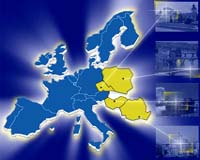
Washington (UPI) March 15, 2004 The new enlargement of the European Union will undoubtedly be more historic and challenging than the previous enlargements were. It effectively ends the division of Europe and the legacy of the Cold War. The question now is, will it also effectively put an end to the European Union as we know it? The answer is affirmative at least to some degree. At 25, the EU can no longer carry on as before. The institutions and methods that were originally established for a community of six countries will not be adequate for the enlarged Union. This is not only because of enlargement to 25 and even more countries, but also because the Union will have much broader competences and responsibilities than the original EEC had. Unfortunately, the new Constitutional Treaty is not yet ready. Based on the work done to date, it is not possible to conclude either if it is going to be adequate enough to cope with our future challenges. Intergovernmental cooperation is gaining momentum at the expense of the community method. This was already the thrust of the convention's proposals, and it means that the inequality between member states will inevitably increase. The commission does not have to be loved nor does its bureaucracy need to understand that a strong commission gives a minimum guarantee that EU decisions are prepared in a manner that assures equal access by and influence of all member states. One of the big challenges will be to avoid the creation of new permanent dividing lines inside the Union. This, together with ensuring the efficiency of the Union's decision-making in the future, should be our main concern in the IGC. Since our failure to conclude the IGC at the latest European Council, we have heard a lot of loose talk about a "core" or a "two-tier" Europe. There seems to be little or no concrete foundation for this kind of talk. Such talk would be more understandable, if it was connected to using the procedures envisaged in the Treaty of Amsterdam for enhanced cooperation, which allow a smaller group of countries to move forward in integration in specific areas, but only as a last resort if it was not possible for everyone to agree to such proposals. Schengen and the Euro group are existing examples of such enhanced cooperation. No one has, however, even hinted at any concrete proposal where this possibility could be used. Apart from cooperation in the field of defense and security, it is very hard even to imagine what such cooperation could cover, and as far as the ESDP (European Security and Defense Policy) is concerned, we already have a consensus in the IGC (Intergovernmental Conference) on how to move forward. What we are seeing is thus not any real core building but bloc building among EU governments. The fact that EU governments meet regularly in different groups and formations to discuss EU issues is nothing new or exceptional. It can even be useful -- provided that the idea is not to create any kind of self-declared directorate to bypass the community method and leave smaller member states in the cold. People can be forgiven for having a growing feeling that ideas and leadership have gone missing in Europe. If so, it is not for lack of demanding and concrete challenges. Enlargement and making Europe competitive in the 21st century (the Lisbon Strategy) are truly grand projects, but it is not necessarily clear what we expect from them. We should ask whether we seek to enhance European competitiveness through a neoliberal agenda and its one-sided emphasis on labour market flexibility, deregulation and profit maximization, or whether we base our reforms on the indisputable strengths of the European social model, such as the ones that are particularly evident in the Nordic welfare states. Such a choice, provided that the European parties are able to present it credibly, could overcome the voter apathy we fear will once again dominate the election of the European Parliament. Arguing about institutional issues will not create queues at the polling stations. In my opinion, the most important challenge the EU faces is how to make the Union a real global player corresponding to the economic and trading power that Europe already possesses. In a world where we face new threats ranging from environmental degradation and communicable diseases to organized crime and terrorism, the EU has a unique opportunity to strengthen effective multilateralism and enhance balanced and equitable globalization on the basis of strengthening human rights, democracy and respect for international law. The EU has a comprehensive Security Strategy, which includes all the instruments of crisis management, civilian and military, as well as prevention of armed conflicts. What we need now is a similar Union strategy for managing globalization. This strategy could spell out how globalization can be better managed in a way that permits a more equal distribution of its benefits. It is also important that democratic principles are respected in decision-making regarding globalization. The proposed Constitutional Treaty contains elements that will permit a more active global role for the Union. The different aspects of the Union's external action -- foreign and trade policy, and development cooperation -- are brought closer together. The external aspects of the EU's internal policies -- concerning, for example, the environment, agriculture and justice and home affairs -- are taken into account more clearly when external action is defined. The external representation of the Union will be strengthened by the creation of the post of an EU Foreign Minister. The demands of globalization are also an important reason to why we should adopt the new Constitutional Treaty as soon as possible. In my speech, I have not touched upon the immediate challenges of the forthcoming enlargement. These challenges -- big as they are -- nevertheless are minor compared to the ones imposed by globalization. Just to give one example, I feel that threat scenarios regarding jobs being transferred from the old Member States to the new ones are based on false assumptions. Instead, we should focus on the implementation of the objectives of Lisbon Strategy -- such as increasing the Union's competitiveness -- in the enlarged Union. In fact, the forthcoming enlargement is not so much about challenges as about opportunities. (Erkki Tuomioja is foreign minister of Finland. This article is adapted from a speech he recently delivered in Copenhagen, Denmark.) (United Press International's "Outside View" commentaries are written by outside contributors who specialize in a variety of issues. The views expressed do not necessarily reflect those of United Press International. In the interests of creating an open forum, original submissions are invited.) All rights reserved. Copyright 2004 by United Press International. Sections of the information displayed on this page (dispatches, photographs, logos) are protected by intellectual property rights owned by United Press International. As a consequence, you may not copy, reproduce, modify, transmit, publish, display or in any way commercially exploit any of the content of this section without the prior written consent of by United Press International. Community Email This Article Comment On This Article Related Links SpaceDaily Search SpaceDaily Subscribe To SpaceDaily Express Space Analysis and Space OpEds
 The Dream Palace Of The Space Cadets
 Honolulu HI (SPX) Nov 24, 2005
I spend some time lurking in many online discussion groups concerned with space travel. From this I have learned that these opinion columns have made me something of a bete noir to the pro-space community. People attribute all kinds of sinister motives and bizarre behaviors to me, just because I try to take a detached and skeptical view of manned space flight. |
|
|

| The content herein, unless otherwise known to be public domain, are Copyright 1995-2006 - SpaceDaily.AFP and UPI Wire Stories are copyright Agence France-Presse and United Press International. ESA PortalReports are copyright European Space Agency. All NASA sourced material is public domain. Additionalcopyrights may apply in whole or part to other bona fide parties. Advertising does not imply endorsement,agreement or approval of any opinions, statements or information provided by SpaceDaily on any Web page published or hosted by SpaceDaily. Privacy Statement |