|
 |
 |
 |
 |
 |
 |
 |
 |

 |
Our Three-Brane Existence
Seattle WA (SPX) Oct 03, 2005 Physicists who work with a concept called string theory envision our universe as an eerie place with at least nine spatial dimensions, six of them hidden from us, perhaps curled up in some way so they are undetectable. The big question is why we experience the universe in only three spatial dimensions instead of four, or six, or nine. Two theoretical researchers from the University of Washington and Harvard University think they might have found the answer. They believe the way our universe started and then diluted as it expanded what they call the relaxation principle favored formation of three- and seven-dimensional realities. The one we happen to experience has three dimensions. "That's what comes out when you do the math," said Andreas Karch, a University of Washington assistant professor of physics and lead author of a new paper that details the theory. Karch and his collaborator, Lisa Randall, a physics professor at Harvard, set out to model how the universe was arranged right after it began in the big bang, and then watch how the cosmos evolved as it expanded and diluted. The only assumptions were that it started with a generally smooth configuration, with numerous structures called membranes, or "branes" that existed in various spatial dimensions from one to nine, all of them large and none curled up. The researchers allowed the cosmos to evolve naturally, without making any additional assumptions. They found that as the branes diluted, the ones that survived displayed three dimensions or seven dimensions. In our universe, everything we see and experience is stuck to one of those branes, and for it to result in a three-dimensional universe the brane must be three-dimensional. Other realities, either three- or seven-dimensional, could be hidden from our perception in the universe, Karch said. "There are regions that feel 3D. There are regions that feel 5D. There are regions that feel 9D. These extra dimensions are infinitely large. We just happen to be in a place that feels 3D to us," he said. In our world, forces such as electromagnetism only recognize three dimensions and behave according to our laws of physics, their strength diminishing with distance. Gravity, however, cuts across all dimensions, even those not recognized in our world, Karch and Randall say. But they theorize that the force of gravity is localized and, with seven branes, gravity would diminish far more quickly with distance than it does in our three-dimensional world. "We know there are people in our three-brane existence. In this case we will assume there are people somewhere nearby in a seven-brane existence. The people in the three-brane would have a far more interesting world, with more complex structures," Karch said. With gravity diminishing rapidly with distance, a seven-dimensional existence would not have planets with stable orbits around their sun, Karch said. "I am not precisely sure what a universe with such a short-range gravity would look like, mostly because it is always difficult to imagine how life would develop under completely different circumstances," he said. "But in any case, planetary systems as we know them wouldn't form. The possibility of stable orbits is what makes the three-dimensional world more interesting." Karch and Randall detail their work in the October edition of Physical Review Letters, published by the American Physical Society. The research was supported by grants from the U.S. Department of Energy and the National Science Foundation. Karch said they hope the work will spark extensive scientific exploration of many other questions involving string theory, extra dimensions and the evolution of the cosmos. Community Email This Article Comment On This Article Related Links SpaceDaily Search SpaceDaily Subscribe To SpaceDaily Express Stellar Chemistry, The Universe And All Within It
 Cartwheel Galaxy Makes Waves In New NASA Image
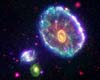 Pasadena CA (JPL) Jan 12, 2006
A new image from NASA's Galaxy Evolution Explorer completes a multi-wavelength, neon-colored portrait of the enormous Cartwheel galaxy after a smaller galaxy plunged through it, triggering ripples of sudden, brief star formation. |
|
|

| The content herein, unless otherwise known to be public domain, are Copyright 1995-2006 - SpaceDaily.AFP and UPI Wire Stories are copyright Agence France-Presse and United Press International. ESA PortalReports are copyright European Space Agency. All NASA sourced material is public domain. Additionalcopyrights may apply in whole or part to other bona fide parties. Advertising does not imply endorsement,agreement or approval of any opinions, statements or information provided by SpaceDaily on any Web page published or hosted by SpaceDaily. Privacy Statement |