|
 |
 |
 |
 |
 |
 |
 |
 |

 |
Organic Building Blocks Discovered In Titan's Atmosphere
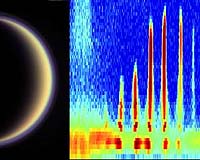
London UK (SPX) Nov 29, 2007 Scientists analysing data gathered by the Cassini spacecraft have confirmed the presence of heavy negative ions in the upper regions of Titan's atmosphere. These particles may act as organic building blocks for even more complicated molecules and their discovery was completely unexpected because of the chemical composition of the atmosphere (which lacks oxygen and mainly consists of nitrogen and methane). The observation has now been verified on 16 different encounters and findings will be published in Geophysical Research Letters on November 28. Professor Andrew Coates, researcher at UCL's Mullard Space Science Laboratory and lead author of the paper, says: "Cassini's electron spectrometer has enabled us to detect negative ions which have 10,000 times the mass of hydrogen. Additional rings of carbon can build up on these ions, forming molecules called polycyclic aromatic hydrocarbons, which may act as a basis for the earliest forms of life. "Their existence poses questions about the processes involved in atmospheric chemistry and aerosol formation and we now think it most likely that these negative ions form in the upper atmosphere before moving closer to the surface, where they probably form the mist which shrouds the planet and which has hidden its secrets from us in the past. It was this mist which stopped the Voyager mission from examining Titan more closely in 1980 and was one of the reasons that Cassini was launched." The new paper builds on work published in Science (May 11) where the team found smaller tholins, up to 8,000 times the mass of hydrogen, forming away from the surface of Titan. Dr Hunter Waite of the South West Research Institute in Texas and author of the earlier study, said: "Tholins are very large, complex, organic molecules thought to include chemical precursors to life. Understanding how they form could provide valuable insight into the origin of life in the solar system." Community Email This Article Comment On This Article Related Links University College London Explore The Ring World of Saturn and her moons Jupiter and its Moons The million outer planets of a star called Sol News Flash at Mercury
 New CU-Boulder Study Confirms First-Known Belt Of Moonlets In Saturn Rings
 Boulder CO (SPX) Oct 25, 2007
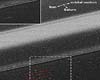
A narrow belt harboring moonlets as large as football stadiums discovered in Saturn's outermost ring probably resulted when a larger moon was shattered by a wayward asteroid or comet eons ago, according to a University of Colorado at Boulder study. Images taken by a camera onboard the NASA Cassini spacecraft revealed a series of eight propeller-shaped "wakes" in a thin belt of the outermost "A" ring, indicating the presence of corresponding moonlets, said CU-Boulder Research Associate Miodrag Sremcevic, lead author of the study published in the Oct. 25 issue of Nature. |
|
|

| The content herein, unless otherwise known to be public domain, are Copyright 1995-2007 - SpaceDaily.AFP and UPI Wire Stories are copyright Agence France-Presse and United Press International. ESA Portal Reports are copyright European Space Agency. All NASA sourced material is public domain. Additional copyrights may apply in whole or part to other bona fide parties. Advertising does not imply endorsement,agreement or approval of any opinions, statements or information provided by SpaceDaily on any Web page published or hosted by SpaceDaily. Privacy Statement |