|
 |
 |
 |
 |
 |
 |
 |
 |

 |
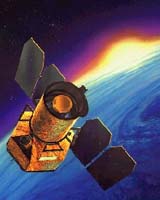
Orbital's Pegasus Rocket Successfully Launches NASA's GALEX Satellite
Dulles - Apr 30, 2003 Orbital Sciences Corporation successfully launched the National Aeronautics and Space Administration (NASA)'s Galaxy Evolution Explorer (GALEX) satellite into its targeted orbit aboard the company's Pegasus rocket Monday. The 312-kilogram (690-pound) GALEX scientific satellite, which Orbital designed and built at its Dulles, Virginia satellite manufacturing facility, was accurately delivered into its targeted orbit approximately 690 kilometers (420 miles) above the Earth, inclined at 29 degrees to the equator. The powered flight sequence for the GALEX mission took about 11 minutes, from the time the Pegasus rocket was released from its L-1011 carrier aircraft at approximately 8:00 a.m. (EDT) to the time that the satellite was deployed into orbit. Preliminary information indicates that the GALEX satellite is working as planned in the early stages of its mission. Pegasus is the world's leading launch system for the deployment of small satellites into low-Earth orbit. Its patented air-launch system, in which the rocket is launched from beneath Orbital's "Stargazer" L-1011 carrier aircraft over the ocean, reduces cost and provides customers with unparalleled flexibility to operate from virtually anywhere on Earth with minimal ground support requirements. Pegasus is the only small launch vehicle to have earned NASA's Category 3 certification, which allows the U.S. space agency to launch its most valuable payloads aboard the rocket. A Category 3 certification is achieved through a long-term record of highly reliable launch services, such as the current record of 19 consecutive successful Pegasus missions carried out since 1997. The GALEX mission was the 33rd flight of the Pegasus rocket and the second of four planned missions in 2003. In January, Orbital successfully launched another company-built satellite, SORCE, for NASA aboard Pegasus. Orbital's next launch will be the OrbView-3 high-resolution imaging satellite, which the company built for ORBIMAGE, in early June. Orbital is also scheduled to launch the SCISAT scientific spacecraft for NASA/Kennedy Space Center and the Canadian Space Agency later in 2003. Community Email This Article Comment On This Article Related Links GALEX at CalTech Explorers Program At Goddard Orbital SpaceDaily Search SpaceDaily Subscribe To SpaceDaily Express Nuclear Space Technology at Space-Travel.com
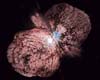
 Carina Nebula Dust Pillars Harbor Embedded Stars
 Boulder CO (SPX) May 31, 2005
Astronomers using NASA's Spitzer Space Telescope have imaged a giant molecular cloud being shredded by howling stellar winds and searing radiation, exposing a group of towering dust pillars harboring infant stars, according to a University of Colorado at Boulder researcher. |
|
|

| The content herein, unless otherwise known to be public domain, are Copyright 1995-2006 - SpaceDaily.AFP and UPI Wire Stories are copyright Agence France-Presse and United Press International. ESA PortalReports are copyright European Space Agency. All NASA sourced material is public domain. Additionalcopyrights may apply in whole or part to other bona fide parties. Advertising does not imply endorsement,agreement or approval of any opinions, statements or information provided by SpaceDaily on any Web page published or hosted by SpaceDaily. Privacy Statement |