|
 |
 |
 |
 |
 |
 |
 |
 |

 |
Orbital Switchboard Celebrates 20 Years Of Service
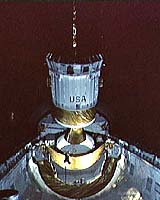
Greenbelt - Apr 08, 2003 NASA's original Tracking and Data Relay Satellite (TDRS-1), launched from the Space Shuttle Challenger (STS-6) in April 1983, went from almost being "lost in space," to a remarkable example of the agency's 'can do, never quit' attitude. On April 4, TDRS-1 celebrates 20 years of outstanding service and 'firsts.' After deployment, the spacecraft's upper stage failed. NASA engineers at the Goddard Space Flight Center (GSFC) came to TDRS-1's rescue using the spacecraft's tiny, one-pound thrusters. They used the thrusters, over several months, to nudge the satellite into a geosynchronous Earth orbit. Because TDRS-1 has been inclining in its orbit almost one degree per year since its deployment, this satellite has been used in ways never expected. TDRS-1 began life by opening a new era in NASA satellite communications. It tracked low Earth-orbiting satellites, enabling NASA to issues commands and receive telemetry through most of their orbit. Working solo, TDRS-1 provided more communication coverage, in support of the September 1983 Shuttle mission, than the entire network of NASA tracking stations had provided in all previous Shuttle missions. The second TDRS satellite was destroyed in the Challenger accident in January 1986, so TDRS-1 was left alone in orbit for several years to carry the load. In March 1992, NASA called on TDRS-1 to quickly aid the agency's Compton Gamma Ray Observatory (CGRO), when data recorders onboard the spacecraft failed. Engineers constructed a ground station in Canberra, Australia to close the zone of communications exclusion and minimize science data loss. Controllers re-positioned TDRS-1 in view of the new station. TDRS-1 was able to supplement the communications services provided by the other on-orbit TDRS satellites, providing the CGRO with downlink capability over previously inaccessible portions of its orbit. Since 1992, NASA has used TDRS-1 for communications to very high latitude ground sites.
Other TDRS-1 firsts include:
Due to increasing orbit inclination, TDRS-1 was the first satellite able to see both Poles. In cooperation with the National Science Foundation (NSF), an uplink/downlink station for TDRS-1 was installed in January 1998 at the exact South Pole. This terminal has given scientists at the Amundsen-Scott Base year around ability to return high volumes of science data to the continental U.S. daily for about five hours. NASA considered retiring the aging satellite in 1998, but instead allowed the NSF and others to use it for scientific, humanitarian and educational purposes. TDRS-1 was used in 1998 for a medical emergency at McMurdo Station. Its high- speed connectivity allowed scientists to conduct a telemedicine conference, allowing doctors in the U.S. to guide a welder through a real operation on a woman diagnosed with breast cancer. In 2000, TDRS-1 successfully supported an extended NSF/Coast Guard science expedition to the Gakal Ridge just below the North Pole. "We in the Space Network are extremely happy with the performance of TDRS-1 and look forward to many more 'firsts,'" said Dick Schonbachler, Mission Commitment Manager at GSFC. Since TDRS-1 entered service in 1983, NASA has placed nine TDRS into specific geosynchronous orbits. Community Email This Article Comment On This Article Related Links The TDRS System SpaceDaily Search SpaceDaily Subscribe To SpaceDaily Express Space Technology News - Applications and Research
 TeleRay Mobile Sat TV Antenna For Japan Auto Market
 Las Vegas CA (SPX) Jan 5, 2006
RaySat has introduced TeleRay, the world's smallest satellite TV vehicle antenna, into the domestic Japanese automotive market. |
|
|

| The content herein, unless otherwise known to be public domain, are Copyright 1995-2006 - SpaceDaily.AFP and UPI Wire Stories are copyright Agence France-Presse and United Press International. ESA PortalReports are copyright European Space Agency. All NASA sourced material is public domain. Additionalcopyrights may apply in whole or part to other bona fide parties. Advertising does not imply endorsement,agreement or approval of any opinions, statements or information provided by SpaceDaily on any Web page published or hosted by SpaceDaily. Privacy Statement |