|
 |
 |
 |
 |
 |
 |
 |
 |

 |
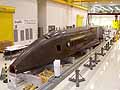
Orbital Ships First X-34 Spaceplane
Dulles - February 25, 1999 - Orbital Sciences has shipped the first X-34 test vehicle from its manufacturing center in Dulles, to the NASA's Dryden Flight Research Center in California. The total value of Orbital's X-34 contract with NASA now stands at approximately $85 million. Orbital is building two additional X-34 vehicles that will be used as technology demonstrators for Reusable Launch Vehicles later this year. This years field tests will encompass the first approach and landing tests followed by 26 unpowered and powered flights for which NASA has contracted with Orbital. "The shipment of the first X-34 vehicle marks the transition from the development phase of the program to the field test phase," said Dr. Robert E. Lindberg, Orbital's Vice President and X-34 Program Manager. "When fully operational, the X-34 will validate and expand the high-speed and high- altitude flight research last carried out by NASA's X-15 spaceplane more than 30 years ago," Lindberg concluded. At Dryden, the X-34 will be subjected to a series of ground and in-flight tests using Orbital's L-1011 carrier aircraft. A team of 15 Orbital engineers and technicians will operate and maintain the spaceplane during these tests. An objective of the X-34 program is to demonstrate that a reusable launch vehicle can be economically flown using a small ground support team. The X-34 is a fully reusable test-bed vehicle that is 58 feet long with a wing span of almost 28 feet. It will be air-launched from beneath Orbital's L-1011 carrier aircraft in similar fashion to Orbital's well-known Pegasus rocket. The X-34 program will demonstrate new technologies that are key to developing and operating RLVs designed to significantly reduce the cost of launching satellites into orbit. Among the technologies that X-34 will demonstrate are an all-composite airframe structure, composite fuel tanks, state-of-the-art thermal protection materials, and autonomous control and landing systems, as well as the ability to conduct flight operations through inclement weather and to safely abort space missions. In addition to its role as a demonstration vehicle for RLV technology, the X-34 has also been designed as a versatile platform with the ability to host a wide variety of high-speed aerospace research projects or micro-gravity experiments, among others.
Reuseable Launch Vehicle Archive at Spacer.Com
X-3X Rotary Kistler Other Space Planes General RLV Industry Issues Email This Article Comment On This Article Related Links Space
 Satellite Launch To Boost DTH In India
 Calcutta, India (SPX) Dec 28, 2005
The successful launch Thursday of India's heaviest satellite from spaceport of Kourou in French Guyana may have boosted the country's space research efforts to yet another level, but it has also lifted the spirits of at least three Direct-To-Home televisions broadcasters, one of which has been waiting for years to launch its services in India. |
|
|

|
|
|
|
|
|
|
|
|
|
|
|
| The content herein, unless otherwise known to be public domain, are Copyright 1995-2006 - SpaceDaily.AFP and UPI Wire Stories are copyright Agence France-Presse and United Press International. ESA PortalReports are copyright European Space Agency. All NASA sourced material is public domain. Additionalcopyrights may apply in whole or part to other bona fide parties. Advertising does not imply endorsement,agreement or approval of any opinions, statements or information provided by SpaceDaily on any Web page published or hosted by SpaceDaily. Privacy Statement |