|
 |
 |
 |
 |
 |
 |
 |
 |

 |
Orbital Receives $11M Order For Minotaur Space Launch Vehicle USAF
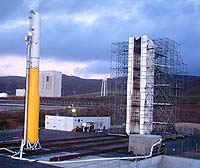
Dulles - Oct 03, 2003 New Order Represents the Fourth Minotaur Rocket Currently Under Firm Contract Orbital Sciences Corporation said Thursday that the U.S. Air Force has exercised an option order for a Minotaur space launch vehicle under the 10-year Orbital/Suborbital Program-2 (OSP-2) contract that was awarded to the company earlier this year. The Minotaur order is the first to be placed under the OSP-2 contract, which is valued at up to $475 million over 10 years on an indefinite delivery/indefinite quantity basis. The new order increases the launch manifest for the Minotaur program to four missions to be carried out over the next two years. This most recent Minotaur space launch vehicle ordered by the Air Force is scheduled to launch a classified payload in 2005. In addition, Orbital is currently under firm contract to carry out three other Minotaur missions, including N-FIRE and XSS-11, both of which are scheduled to be launched in 2004, and COSMIC, scheduled for launch in 2005. "We are very pleased to have the opportunity to conduct cost-effective military space missions for the Department of Defense," said Mr. Ron Grabe, Orbital's Executive Vice President and General Manager of its Launch Systems Group. "The Minotaur program represents an efficient use of government assets and commercial technology to provide low-cost, operationally responsive and reliable launch services for U.S. government customers." Orbital originally developed the four-stage Minotaur rocket under the Air Force's OSP-1 contract, which was awarded to the company in 1997. The Minotaur vehicle uses government-supplied Minuteman II rocket motors that serve as the vehicle's first and second stages. The rocket's third and fourth stages, as well as its guidance and control system, use technology from Orbital's highly reliable Pegasus XL commercial rocket program. Orbital has carried out two previous Minotaur missions, both of which were fully successful. In January 2000, Minotaur made its successful debut with the launch of the JAWSAT spacecraft. Later in 2000, the second Minotaur rocket successfully launched the MightySat-II satellite into low-Earth orbit. Both missions were conducted from launch facilities at Vandenberg Air Force Base (VAFB), CA. Community Email This Article Comment On This Article Related Links Orbital Sciences Corporation SpaceDaily Search SpaceDaily Subscribe To SpaceDaily Express Learn about missile defense at SpaceWar.com Learn about nuclear weapons doctrine and defense at SpaceWar.com All about missiles at SpaceWar.com Learn about the Superpowers of the 21st Century at SpaceWar.com
 Missile Defense Program Moves Forward
 Washington DC (AFPS) Jan 12, 2006
The Missile Defense Agency continues to move forward in its efforts to protect the nation against a ballistic missile attack. The eighth ground-based interceptor missile was lowered into its underground silo at Fort Greely, Alaska, Dec. 18, 2005. |
|
|

| The content herein, unless otherwise known to be public domain, are Copyright 1995-2006 - SpaceDaily.AFP and UPI Wire Stories are copyright Agence France-Presse and United Press International. ESA PortalReports are copyright European Space Agency. All NASA sourced material is public domain. Additionalcopyrights may apply in whole or part to other bona fide parties. Advertising does not imply endorsement,agreement or approval of any opinions, statements or information provided by SpaceDaily on any Web page published or hosted by SpaceDaily. Privacy Statement |