|
 |
 |
 |
 |
 |
 |
 |
 |

 |
Orbital Launches Minotaur II Target Vehicle In ABM Sensor Test
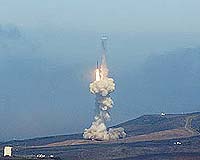
Dulles VA (SPX) Mar 30, 2007 Orbital Sciences reports that its Minotaur II rocket was successfully launched for the U.S. Air Force Space and Missile Systems Center in support of advanced sensor testing by the Missile Defense Agency. The mission was conducted on Tuesday, March 20, 2007, from Vandenberg Air Force Base, California. The Air Force program office for Minotaur II is the 3rd Space Test Squadron of the Space Development and Test Wing (SDTW) at Kirtland Air Force Base, New Mexico. This mission was the sixth for the Minotaur II Target Launch Vehicle (TLV) and the 12th for the Minotaur family, all of which have been successful. The launch originated from VAFB at approximately 9:27 p.m. (PDT) on March 20. The vehicle's three solid rocket motors burned for approximately three minutes, putting it on a trajectory to a precise aim point nearly 4,000 nautical miles to the west over the Pacific Ocean. The vehicle was observed by a variety of MDA sensors deployed across the Pacific. Orbital is one of the country's leading suppliers of launch vehicles used in missile defense applications. In addition to numerous configurations of target vehicles, Orbital is also designing and building the interceptor boosters for two major missile defense programs, including the Ground-based Midcourse Defense (GMD) system, which uses the company's three-stage Orbital Boost Vehicle (OBV), and the Kinetic Energy Interceptors (KEI) program, which is designed to intercept and destroy enemy missiles in the early boost phase of flight. These interceptors are part of a layered missile defense system for defending the nation, our armed forces and our allies against ballistic missile attacks. Orbital's Minotaur product line was developed under the U.S. Air Force's Orbital/Suborbital Program (OSP). The initial five-year OSP contract was competitively awarded to Orbital in 1997 and the company also won the follow-on 10-year OSP-2 contract in 2003. The Minotaur II target launch vehicle design used in the recent launch is one of the two original members of Orbital's growing family of Minotaur launch vehicles, which includes both space launch vehicles and long-range suborbital vehicles for missile defense and other specialized launch missions. Prior to this mission, the most recent launch of the Minotaur family was in December 2006 when a Minotaur I space launch vehicle (SLV) successfully placed the TacSat-2 spacecraft into orbit from Wallops Island, Virginia in a demonstration of Operationally Responsive Space (ORS) capabilities. Community Email This Article Comment On This Article Related Links Orbital Minotaur II launch Learn about missile defense at SpaceWar.com Learn about missile defense at SpaceWar.com Learn about nuclear weapons doctrine and defense at SpaceWar.com All about missiles at SpaceWar.com Learn about the Superpowers of the 21st Century at SpaceWar.com
 US Offers To Boost Missile Cooperation with Russia
 Brussels (AFP) March 29, 2007
The United States offered Thursday to boost cooperation with Russia on missile defence, including sharing technologies and research as well as developing missile defence systems. |
|
|

| The content herein, unless otherwise known to be public domain, are Copyright 1995-2006 - SpaceDaily.AFP and UPI Wire Stories are copyright Agence France-Presse and United Press International. ESA PortalReports are copyright European Space Agency. All NASA sourced material is public domain. Additionalcopyrights may apply in whole or part to other bona fide parties. Advertising does not imply endorsement,agreement or approval of any opinions, statements or information provided by SpaceDaily on any Web page published or hosted by SpaceDaily. Privacy Statement |