|
 |
 |
 |
 |
 |
 |
 |
 |

 |
Orbital Issues DART Mission Recap
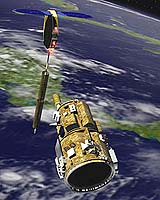
Dulles VA (SPX) Apr 19, 2005 Orbital Sciences issued Monday a recap of the Demonstration of Autonomous Rendezvous Technology (DART) mission that it carried out last Friday and Saturday for NASA. Orbital was the prime contractor for the mission, with responsibility for both the Pegasus launch vehicle and the DART research and development spacecraft. The company stated that the launch of the DART spacecraft aboard its Pegasus rocket was a full success; however, the in-orbit operations of the DART spacecraft achieved only a partial set of its mission objectives and concluded earlier than planned. Approximately 12 hours into a 24-hour operation, the DART vehicle's autonomous control systems correctly initiated the mission's retirement phase when low onboard fuel levels were detected. The cause for the higher than planned fuel consumption is now under investigation by a committee convened by NASA. The DART mission began with the successful launch of Orbital air-launched Pegasus rocket at approximately 1:25 p.m. (EDT) on Friday, April 15. Following a 12-minute flight, the Pegasus rocket accurately placed the DART spacecraft into its targeted orbit, approximately 545 km (340 miles) above the Earth. It was the 22nd consecutive successful mission for the Pegasus space launch vehicle program since 1997 and its 36th flight since its debut in 1990. Following its deployment from Pegasus, the DART spacecraft embarked on a planned 24-hour mission to locate, rendezvous with and conduct close-proximity maneuvers around another in-orbit satellite, all without the benefit of human pilots or ground controllers directing the mission operations. Orbital stated that DART successfully completed the location and rendezvous phases of its operations, closing to within approximately 92 meters (300 feet) of the mission's target satellite, the Multiple Paths Beyond Line-of-Sight Communications (MUBLCOM) spacecraft, which Orbital built and launched in 1999 and which completed its original mission several years ago. DART's Advanced Video Guidance System (AVGS) instrument also was able to acquire the MUBLCOM satellite, accomplishing one of the mission's key R&D objectives. The DART spacecraft was unable to complete all of its close proximity and circumnavigation operations near the MUBLCOM satellite due to the depleted fuel situation. Orbital designed, developed, built and tested the DART spacecraft for NASA's Marshall Space Flight Center in Huntsville, AL. The goal of the DART mission was to test technologies that may be applied to future manned and unmanned missions of the U.S. space program that require in-space assembly, servicing, docking or other autonomous rendezvous operations. Community Email This Article Comment On This Article Related Links Orbital SpaceDaily Search SpaceDaily Subscribe To SpaceDaily Express All about the robots on Earth and beyond!
 Engineers Deliver Robot to Neutralize Remote Explosives
 Tyndall AFB (SPX) Jun 30, 2005
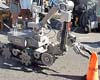
Engineers from the Air Force Research Laboratory Materials and Manufacturing Directorate have rapidly prototyped, developed, and delivered low-cost expendable robots to disable and dispose of improvised explosive devices. |
|
|

| The content herein, unless otherwise known to be public domain, are Copyright 1995-2006 - SpaceDaily.AFP and UPI Wire Stories are copyright Agence France-Presse and United Press International. ESA PortalReports are copyright European Space Agency. All NASA sourced material is public domain. Additionalcopyrights may apply in whole or part to other bona fide parties. Advertising does not imply endorsement,agreement or approval of any opinions, statements or information provided by SpaceDaily on any Web page published or hosted by SpaceDaily. Privacy Statement |