|
 |
 |
 |
 |
 |
 |
 |
 |

 |
Orbital Express Program Moves Ahead With Phase 2 Award
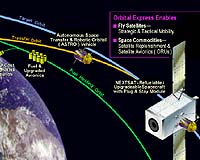
Washington - Mar 13, 2002 The Defense Advanced Research Projects Agency (DARPA) announced Friday the selection of Boeing's Phantom Works at Seal Beach in California as the team to perform Phase II of the Orbital Express Advanced Technology Demonstration. The team received a $99,144,499 modification to another transaction for prototypes agreement. The team will contribute an additional $13,340,000 in cost-share. Team members include: Ball Aerospace and Technologies Corp., Boulder, Colo.; TRW, Space and Technology Division, Redondo Beach, Calif.; MD Robotics, Brampton, Ontario, Canada; and Charles Stark Draper Laboratory Inc., Cambridge, Mass. During this 42-month phase, the Boeing team will finalize the design, develop and fabricate a prototype servicing satellite, the Autonomous Space Transport Robotic Operations satellite (ASTRO), and a surrogate serviceable satellite, NextSat, and conduct an on-orbit demonstration to validate the technical feasibility and mission utility of autonomous, robotic on-orbit satellite servicing. A key element of this demonstration is a non-proprietary satellite servicing interface standard that can be implemented by any satellite manufacturer to enable servicing. DARPA strongly believes that routine, autonomous satellite servicing will provide spacecraft with unprecedented freedom of maneuver, allowing satellite coverage to be adjusted or optimized at will, or enabling spacecraft to employ unpredictable maneuvers to counter possible threats or adversary activity scheduling. It is also anticipated that routine, autonomous, preplanned upgrades or reconfiguration of spacecraft components will dramatically reduce the "time to market" of new technology into operational satellites, improving mission performance more efficiently than through block replacements of satellite constellations. DARPA foresees that an Orbital Express-derived satellite servicing architecture will usher in a revolution in space operations, enabling new and enhanced satellite capabilities supporting not only national security missions, but civil and commercial space activities as well. Maj. James Shoemaker, USAF, DARPA's Orbital Express program manager, explained, "Robotic on-orbit satellite servicing has been analyzed many times, has always looked good on paper, but has always been judged to have too high a technical risk and cost uncertainty to convince a program manager to implement on-orbit servicing in an operational satellite program. Orbital Express will demonstrate the key enabling technologies for on-orbit servicing, and provide real-world experience that will enable future operational systems to make decisions based on facts rather than assumptions." Community Email This Article Comment On This Article Related Links Orbital Express Advanced Technology Demonstration Search SpaceDaily Subscribe To SpaceDaily Express Military Space News at SpaceWar.com
 Space Group To Activate New Unit
 Colorado Springs CO (SPX) Jan 6, 2006
Air Force Reserve Command's 310th Space Group will travel deeper into the space program when it activates a new unit Jan. 7. Headquarters Reserve National Security Space Institute will be a Reserve associate unit to the National Security Space Institute in Colorado Springs, Colo. The institute is the Department of Defense's focal point for providing education about space power in joint warfighting. |
|
|

| The content herein, unless otherwise known to be public domain, are Copyright 1995-2006 - SpaceDaily.AFP and UPI Wire Stories are copyright Agence France-Presse and United Press International. ESA PortalReports are copyright European Space Agency. All NASA sourced material is public domain. Additionalcopyrights may apply in whole or part to other bona fide parties. Advertising does not imply endorsement,agreement or approval of any opinions, statements or information provided by SpaceDaily on any Web page published or hosted by SpaceDaily. Privacy Statement |