|
 |
 |
 |
 |
 |
 |
 |
 |

 |
Orbital Evolution Of Asteroid Itokawa
Tokyo, Japan (SPX) Oct 28, 2005 What orbit did the asteroid Itokawa follow in the past? Where will it go? We have studied the orbital evolution of Itokawa. This study will give some useful information, when we explain the observation results by Hayabusa.
Orbit of Itokawa If an asteroid is in an orbit that approach planets, its orbital evolution becomes chaotic. This means that the negligibly small difference in the initial condition will become very large quite soon. There is error in the determined orbit, and by this error we cannot predict its future orbit if the orbital evolution is chaotic. Asteroid Itokawa is indeed in such situation.
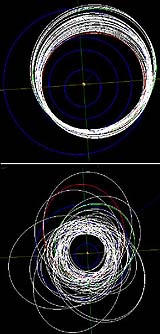
Fig.1 Orbit of Itokawa
2. Orbital evolution of Itokawa At first, we studied the orbital evolution of Itokawa in the past by statistical methods. As the results, it is found that Itokawa possibly existed near the present orbit at 5000 years ago. We can estimate origin of Itokawa by using an steady state model of orbital evolution of near earth objects. The detail things are omitted here, but it is found that Itokawa probably came to the present orbit from a region where a certain kind of resonance occurs or the region where the orbit crosses Mars orbit. Thus we can say the origin of Itokawa may be near the inner part in the asteroid belt. However, it is difficult to know when the orbit of Itokawa became current one. The typical time scale of such orbital change is about several million years. Maybe we can get some clues from the observation by Hayabusa. Next, we studied the orbital evolution of Itokawa about 100 million years in the future, and we found that the fate of Itokawa ends most probably by a collision with the sun or planets (Mercury, Venus, Earth, Mars). Only in a small probability, it collides to Jupiter, or it is thrown away farther than Saturn, or it is still alive orbiting in the near earth region. The probability of colliding with the earth is about once in one million years. The collision frequency of about Itokawa-size objects (about 500m) is said to be about once in several hundred thousand years, so the collision probability of Itokawa is rather high as only one object. Fig.2 (shown) shows the orbital changes of two cases ("clones"), which finally collide to the earth. Especially for the case of long periods, the orbit is changing very largely. This shows chaotic motion straightforwardly. (You do not have to worry about the earth collision of Itokawa in near future.)
Summary
The orbital evolution of Itokawa is as follows: Itokawa is in an orbit that approaches the earth and Mars. The orbit motion is strongly chaotic and we can trace its orbit only for about 200 years. Itokawa most probably collides to Sun or planets (Mercury, Venus, Earth, Mars). In a small probability, it remains alive more than 100 million years, or its orbit becomes larger than that of Jupiter. The probability of the collision to the earth is about once in one million years. As the summary, Itokawa has evolved to the current orbit from the inner part of the asteroid belt, and it will collide to the sun or the planets (Mercury, Venus, Earth, Mars). This is the typical evolution of near earth objects. This means that the information that HAYABUSA gets from Itokawa is important for spaceguard as well as the studies of asteroid origin and asteroid-meteorite relationship. Community Email This Article Comment On This Article Related Links Japan Aerospace Exploration Agency (JAXA) SpaceDaily Search SpaceDaily Subscribe To SpaceDaily Express Asteroid and Comet Mission News, Science and Technology
 NASA'S Spitzer Finds Possible Comet Dust Around Dead Star
 Pasadena CA (SPX) Jan 12, 2006
NASA's Spitzer Space Telescope has spotted what may be comet dust sprinkled around the white dwarf star G29-38, which died approximately 500 million years ago. |
|
|

| The content herein, unless otherwise known to be public domain, are Copyright 1995-2006 - SpaceDaily.AFP and UPI Wire Stories are copyright Agence France-Presse and United Press International. ESA PortalReports are copyright European Space Agency. All NASA sourced material is public domain. Additionalcopyrights may apply in whole or part to other bona fide parties. Advertising does not imply endorsement,agreement or approval of any opinions, statements or information provided by SpaceDaily on any Web page published or hosted by SpaceDaily. Privacy Statement |