|
 |
 |
 |
 |
 |
 |
 |
 |

 |
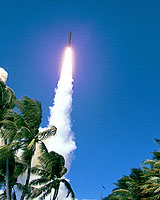
Orbital Carries Out Third Launch of Missile Defense Interceptor Vehicle
Dulles - Jan 29, 2004 Orbital Sciences Corporation said Tuesday that the company's missile defense interceptor boost vehicle, being developed and manufactured for the U.S. Missile Defense Agency's (MDA) Ground-based Midcourse Defense (GMD) system, carried out its third fully successful test flight late yesterday. As part of MDA's Integrated Flight Test-13b (IFT-13b), Orbital's GMD interceptor vehicle, which carried a mock kill vehicle to simulate actual mission operations, was launched from a silo at approximately 9:23 p.m. (EST) on January 26, 2004. The IFT-13b flight originated from the Reagan Test Site on Kwajalein Atoll in the Marshall Islands, located in the mid-Pacific Ocean. Following preliminary post-flight analysis of the data collected from the mission, Orbital confirmed that all primary objectives for the vehicle's third launch were achieved. The objectives for the mission included the second demonstration of the vehicle's silo-launch capabilities, the verification of the vehicle's design and flight characteristics while carrying a simulated kill vehicle, and further confirmation of the planned performance of its guidance, control and propulsion systems. Orbital's GMD boost vehicle is a three-stage rocket based on flight-proven hardware that has flown over 45 times on missions carried out by the company's Pegasus, Taurus and Minotaur space launch vehicles. Orbital is developing, manufacturing and testing interceptor vehicles under a multi-year contract from The Boeing Company.. "We are very pleased that our GMD interceptor vehicle successfully carried out its role in the integrated flight test," said Mr. Ron Grabe, Executive Vice President and General Manager of Orbital's Launch Systems Group. "We have continued to meet the progressively more challenging test conditions for our vehicle, which will lead to more extensive testing and operational deployment later this year." The successful launch of the GMD boost vehicle was the company's first space mission in 2004 following two consecutive years of fully successful missions encompassing 26 rocket launches and satellite deployments. Orbital is expecting 2004 to be one of the busiest years in its history, with approximately 20 major space missions and up to 20 additional system deliveries to be completed for a wide range of military, scientific and commercial missions for domestic and international customers. Orbital's space launch vehicles, missile defense interceptors and related suborbital rockets are primarily produced at the company's engineering and manufacturing facility in Chandler, Arizona and its vehicle assembly and integration facilities at Vandenberg Air Force Base in California. The launch vehicles are used by commercial and government customers to deliver small satellites into low altitude orbits above the Earth and in missile defense systems, both as threat-simulating target vehicles and as interceptor boosters for U.S. national defense systems. Community Email This Article Comment On This Article Related Links Orbital Missile Defense Agency SpaceDaily Search SpaceDaily Subscribe To SpaceDaily Express Learn about missile defense at SpaceWar.com Learn about nuclear weapons doctrine and defense at SpaceWar.com All about missiles at SpaceWar.com Learn about the Superpowers of the 21st Century at SpaceWar.com
 Missile Defense Program Moves Forward
 Washington DC (AFPS) Jan 12, 2006
The Missile Defense Agency continues to move forward in its efforts to protect the nation against a ballistic missile attack. The eighth ground-based interceptor missile was lowered into its underground silo at Fort Greely, Alaska, Dec. 18, 2005. |
|
|

| The content herein, unless otherwise known to be public domain, are Copyright 1995-2006 - SpaceDaily.AFP and UPI Wire Stories are copyright Agence France-Presse and United Press International. ESA PortalReports are copyright European Space Agency. All NASA sourced material is public domain. Additionalcopyrights may apply in whole or part to other bona fide parties. Advertising does not imply endorsement,agreement or approval of any opinions, statements or information provided by SpaceDaily on any Web page published or hosted by SpaceDaily. Privacy Statement |