|
 |
 |
 |
 |
 |
 |
 |
 |

 |
OrbComm Completed With Pegasus Launch
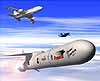
Dulles - September 23, 1998 - Orbital Sciences successfully deployed an air-launched Pegasus XL rocket early Wednesday morning from NASA's Wallops Flight Facility, Virginia. Onboard were eight communications satellites for affiliated company OrbComm Global. The launch completes the final space segment of OrbComm's worldwide data communications network that will provide messaging and monitoring services via low cost terminals. The Pegasus rocket accurately delivered the new satellites into their targeted orbit approximately 818 kilometers (510 miles) above the Earth, where they joined 20 similar OrbComm satellites previously launched by Orbital rockets. For the Pegasus launch system, today's mission was the 14th consecutive successful mission dating back to 1996, and the 23rd overall mission for the innovative airborne space launch vehicle. With this flight, Pegasus has now launched 16 OrbComm satellites in less than eight weeks. Preliminary information gathered following the launch indicates that all eight OrbComm satellites separated successfully from the launch vehicle and that initial communications with the new satellites is progressing as expected. Over the next several days, a team of Orbital and OrbComm engineers will conduct a series of early in-orbit tests to confirm that the satellites are operating as planned. Following this initial evaluation phase, the engineering team will conduct a more comprehensive series of performance tests over the next several months in preparation for placing the satellites into commercial service. Mr. David W. Thompson, Orbital's President and Chief Executive Officer, said, "We are very excited to have OrbComm's initial satellite network now in place. Within several months, when the eight new satellites are expected to be commissioned for commercial service, OrbComm will offer its growing customer base enhanced data communications services on a worldwide scale." Mr. Thompson added, "I am extremely proud of our Pegasus launch team whose focus on high reliability and on-time performance has firmly established Orbital as the world's leader in small launch vehicles. I also want to congratulate our satellite group, which has now delivered and launched a total of 30 spacecraft in the past 15 months." With today's successful launch, Orbital has completed the construction and launch of the 28-satellite space segment for OrbComm Global that will enable it to offer low-cost data communications services in the United States and virtually all other regions around the world. In addition to the 28 satellites now in orbit, OrbComm's ground network in the United States is also complete, anchored by a fully-functioning, ultra-modern Network Control Center in Dulles, Virginia and four strategically-located ground "gateway" stations in Washington State, Arizona, New York State and Georgia. OrbComms international presence is also rapidly expanding, highlighted by the 16 regional distribution partners who are preparing to offer OrbComm's communications services in a total of 105 countries around the world. As of today, 14 international gateway stations are installed or under construction in Europe, Asia, South America and Africa, with more to be added in the coming months. Orbital is the founder and 50% owner of OrbComm Global, L.P., with other partners Teleglobe Inc. of Canada and Technology Resources Industries Bhd. of Malaysia. Today's launch originated from NASA's Wallops Flight Facility located on the southeastern coast of Virginia and was sponsored by the Virginia Space Flight Center, a newly-created commercial spaceport. The company's "Stargazer" Pegasus carrier aircraft took off at approximately 12:10 a.m. this morning. The L-1011 aircraft flew off the Virginia coast at an altitude of 40,000 feet to a predetermined launch point over the Atlantic Ocean. After being released from its carrier aircraft at approximately 1:06 a.m., the Pegasus rocket ignited its first stage motor after a planned five-second free fall. Following an approximate 75 minute flight, Pegasus delivered all eight OrbComm satellites into their targeted orbits at an altitude of approximately 818 kilometers (510 miles), inclined at 45 degrees to the equator. Following the separation of the last of the eight satellites, Pegasus completed the planned burn of its remaining hydrazine fuel.
OrbComm Reports From Spacer.Com
Orbital Sciences Reports From Spacer.Com
Email This Article Comment On This Article Related Links Space
 Satellite Launch To Boost DTH In India
 Calcutta, India (SPX) Dec 28, 2005
The successful launch Thursday of India's heaviest satellite from spaceport of Kourou in French Guyana may have boosted the country's space research efforts to yet another level, but it has also lifted the spirits of at least three Direct-To-Home televisions broadcasters, one of which has been waiting for years to launch its services in India. |
|
|

|
|
|
|
|
|
|
|
|
|
|
|
| The content herein, unless otherwise known to be public domain, are Copyright 1995-2006 - SpaceDaily.AFP and UPI Wire Stories are copyright Agence France-Presse and United Press International. ESA PortalReports are copyright European Space Agency. All NASA sourced material is public domain. Additionalcopyrights may apply in whole or part to other bona fide parties. Advertising does not imply endorsement,agreement or approval of any opinions, statements or information provided by SpaceDaily on any Web page published or hosted by SpaceDaily. Privacy Statement |