|
 |
 |
 |
 |
 |
 |
 |
 |

 |
Optical Trap Provides New Insights Into Motor Molecules
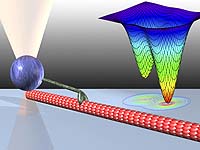
Stanford - Mar 03, 2003 When it comes to nanotechnology, many researchers turn to nature for inspiration. Of particular interest to nanoengineers is the naturally occurring protein kinesin - one of several "motor molecules" that facilitate movement in living cells. A mere ten-millionth of an inch long, kinesin is the workhorse of the cell, hauling chromosomes, neurotransmitters and other vital cargo along tiny tracks called "microtubules." While one end of a kinesin molecule holds onto its cargo, the other end uses a strange two-headed structure to grab the microtubule and pull the cargo forward. To engineers, kinesin's remarkably fuel-efficient motor serves as the ideal model for a variety of futuristic nanotechnologies - from nanofactories that would fit inside a computer chip to nanoimplants that could be placed under the skin and deliver minute doses of medication to targeted cells. If devices are to become reality, researchers first need to solve a fundamental mystery about kinesin: How does it move? A new laser microscope designed by Stanford University scientist Steven Block and his co-workers is providing new clues. Their latest results are published in the March 3 edition of the Proceedings of the National Academy of Sciences (PNAS).
Controversial movement The Block lab's newest instrument - called a "two-dimensional optical force clamp" - gives researchers unprecedented ability to control and observe individual kinesin molecules. "Using an invisible beam of infrared light, we can grasp and manipulate small things in the microscope, move them around at will and put forces on them," Block explained. "The forces are very feeble, because they're associated with light pressure, but they're sufficiently strong to be able to pull on biological molecules of interest." Block and his co-workers are the first to successfully apply a full range of forces to a single kinesin molecule as it moved along a microtubule. Writing in PNAS, the researchers described how they coaxed each molecule to haul a tiny silica bead. The kinesin and bead were then optically trapped and subjected to minute forces in four directions - forward, backward, left and right. "It turns out that when you apply a sideways force, you slow down the motor a bit but not much - 30 percent or so," said physics graduate student Joshua Shaevitz, co-author of the PNAS study. "In contrast, when you pull backward, the molecule slows down a lot, which you'd expect." The surprise came when a force was applied from the rear. The molecule kept going the same speed as if no force was applied at all. "It didn't speed up, it barely did anything," Shaevitz noted. "That's a new finding." Shaevitz compared the results to an automobile going downhill. The car would accelerate, unless something in the motor or transmission was slowing it down. Likewise, there may be something in kinesin's biochemical pathway that keeps it on a steady pace even though it is being pulled forward.
Surprising results Do these findings vindicate the hand-over-hand model of how kinesin walks, or could there be another explanation? It's still an open question, according to Asbury. "A lot of people like the idea that it goes hand-over-hand, but maybe we're just anthropomorphizing," he noted. "Recent evidence points toward an inchworm model, where one head reaches out and grabs the microtubule, while the other head just comes along for the ride. In any case, we're staying neutral." The Block lab is planning new experiments that one day may solve the riddle of how kinesin walks - providing a potential boost for nanotechnologists everywhere. "This is one of the most efficient engines anyone has ever seen," Shaevitz noted. "Some estimates put it at near 100 percent efficiency. It's an amazing little thing." Asbury agreed: "Kinesin is an example of where Mother Nature kicks our butt. For me, I'm motivated just by understanding how this fascinating thing works." Former Stanford postdoctoral fellow Matthew Lang, now at the Massachusetts Institute of Technology, also co-authored the PNAS study. Financial support was provided by the National Institute of General Medical Sciences and the Cancer Research Fund of the Damon Runyun-Walter Winchell Foundation Fellowship. Community Email This Article Comment On This Article Related Links Kinesin Reaction Cycles with 2D Optical Force Clamps: Full Paper SpaceDaily Search SpaceDaily Subscribe To SpaceDaily Express Nano Technology News From SpaceMart.com Computer Chip Architecture, Technology and Manufacture
 Water, Water Everywhere Nano
 New York (UPI) Mar 18, 2005
One of the single biggest applications of nanotechnology could be solving the global shortage of pure water, experts told UPI's Nano World. |
|
|

| The content herein, unless otherwise known to be public domain, are Copyright 1995-2006 - SpaceDaily.AFP and UPI Wire Stories are copyright Agence France-Presse and United Press International. ESA PortalReports are copyright European Space Agency. All NASA sourced material is public domain. Additionalcopyrights may apply in whole or part to other bona fide parties. Advertising does not imply endorsement,agreement or approval of any opinions, statements or information provided by SpaceDaily on any Web page published or hosted by SpaceDaily. Privacy Statement |