|
 |
 |
 |
 |
 |
 |
 |
 |

 |
Optical Scientist Develops Window for Space Station
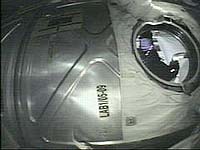
San Diego - Feb. 13, 2001 The first astronauts to view Earth from the International Space Station looked through a glass porthole developed by Dr. Karen Scott of The Aerospace Corporation's Space Architecture Department, Houston. From the U.S. laboratory module element of the space station, the 20-inch-diameter window provides a view of more than 75 percent of Earth's surface, containing 95 percent of the world's population. Astronauts will conduct long-term global monitoring of Earth with remote-sensing experiments and with photographs taken through the highest quality optical window ever installed in a crewed spacecraft. Scott has been the primary optical scientist for developing the window. She wrote the optical requirements, performed analyses, and conducted additional optical testing of the general-quality laboratory windows, informing management of the need for an upgrade. Original plans did not call for optical glass to be used for the Earth-oriented nadir window. General viewing glass, basically shuttle glass derived from X-15 aircraft window requirements and designed primarily to support pilots in landing the shuttle, was to be used. The glass, however, wouldn't support viewing with high-resolution telescopes or allow operation of precision remote-sensing instruments. Scott's upgrade of a four-piece window, now consisting of a thin exterior "debris" pane, primary and secondary pressure panes, and an interior "scratch" pane, was approved. A calibration test was needed to give researchers the necessary information to correct their data for the effects of the window glass on incoming light, and to determine what corrections would be required to carry out spectral remote-sensing research from the nadir window. Scott led a 30-member team from Johnson and Kennedy Space Centers, Marshall Space Flight Center and the University of Arizona Remote Sensing Group, which used $500,000 in optical instrumentation to make calibration measurements on the science window before installing it in the lab module. After a week of 12-hour test days, the lab window was determined to have the characteristics that would allow it to support a wide variety of research applications, including coral reef monitoring, the development of new remote-sensing instruments, and monitoring of Earth's upper atmosphere. Community Email This Article Comment On This Article Related Links Aerospace Corp SpaceDaily Search SpaceDaily Subscribe To SpaceDaily Express Space Tourism, Space Transport and Space Exploration News
 NASA Refines Design For Crew Exploration Vehicle
 Washington DC (SPX) Jan 12, 2006
NASA's Constellation Program is making progress toward selecting a prime contractor to design, develop and build the Crew Exploration Vehicle (CEV), America's first new human spacecraft in 30 years. |
|
|

|
|
|
|
|
|
|
|
|
|
|
|
| The content herein, unless otherwise known to be public domain, are Copyright 1995-2006 - SpaceDaily.AFP and UPI Wire Stories are copyright Agence France-Presse and United Press International. ESA PortalReports are copyright European Space Agency. All NASA sourced material is public domain. Additionalcopyrights may apply in whole or part to other bona fide parties. Advertising does not imply endorsement,agreement or approval of any opinions, statements or information provided by SpaceDaily on any Web page published or hosted by SpaceDaily. Privacy Statement |