|
 |
 |
 |
 |
 |
 |
 |
 |

 |
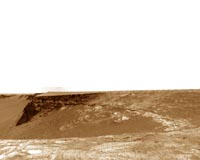
Opportunity Looks For Entry Point Into Crater
Pasadena CA (SPX) Dec 20, 2006 Opportunity is healthy and driving toward "Bottomless Bay" to gather data on whether this would be a suitable future entry point into "Victoria Crater." The rover will continue traversing the crater rim and collecting images of the cliff walls. On Dec. 6, 2006, corresponding to the 1020th sol, or Martian day, of Opportunity's mission on the surface of Mars, NASA's Mars Odyssey orbiter entered safe mode, a protective state during which only those systems vital to the orbiter's health continue to operate. Odyssey provides the relay communications link for most data received from the Opportunity and Spirit rovers. Rover handlers responded to the temporary unavailability of Odyssey by planning only one sol of driving and limiting remote sensing activities until the orbiter returned to normal relay mode on Opportunity's sol 1026 (Dec. 12, 2006). Between sols 1021 (Dec. 7, 2006) and 1027 (Dec. 13, 2006), Opportunity drove 84 meters (276 feet). Sol-by-sol summaries: Sol 1022 (Dec. 8, 2006): Opportunity took backward-looking panoramic images, monitored the rover mast for dust, acquired thumbnail panoramic images of the sky, and measured atmospheric dust. Sol 1023: Opportunity measured atmospheric dust and acquired forward-looking images using the panoramic camera, acquired images to accompany surveys by the miniature thermal emission spectrometer using the navigation camera, and scanned the sky and ground using the miniature thermal emission spectrometer. The rover monitored atmospheric dust at sunset, measured atmospheric density of argon gas with the alpha-particle X-ray spectrometer, and scanned the sky for clouds with the navigation camera. Sol 1024: Opportunity measured atmospheric dust with the panoramic camera, scanned the sky and ground with the miniature thermal emission spectrometer, and acquired panoramic camera images of the work volume to be examined using the instruments on the rover's robotic arm. Sol 1025: Opportunity measured atmospheric dust with the panoramic camera, surveyed the sky and ground with the miniature thermal emission spectrometer, scanned the sky for clouds with the navigation camera, and acquired thumbnail images of the sky using the panoramic camera. Sol 1026: Opportunity measured atmospheric dust with the panoramic camera, surveyed the horizon with the miniature thermal emission spectrometer, scanned the sky for clouds with the navigation camera, and acquired thumbnail images of the sky using the panoramic camera. Sol 1027: Opportunity measured atmospheric dust with the panoramic camera, drove 30 meters (98 feet), acquired navigation camera images of the area ahead, and acquired post-drive panoramic camera images and atmospheric dust measurements. The rover surveyed the sky and ground with the miniature thermal emission spectrometer and scanned the sky for clouds with the navigation camera. Sol 1028 (Dec. 14, 2006): Opportunity measured atmospheric dust with the panoramic camera, drove 40 meters (131 feet), took post-drive navigation camera images, monitored the rover mast for dust, and surveyed the sky and ground with the miniature thermal emission spectrometer. Odometry: As of sol 1027 (Dec. 13, 2006), Opportunity's total odometry was 9,669 meters (6.01 miles). Community Email This Article Comment On This Article Related Links Mars Rovers at JPL Mars Rovers at Cornell Mars News and Information at MarsDaily.com Mars News and Information at MarsDaily.com Lunar Dreams and more
 Latest Spirit Update - Relay Link Restored After Orbiter's Recovery
 Washnington DC (SPX) Dec 19, 2006
After Spirit drove on sol 1041 (Dec. 7, 2006), NASA's Mars Odyssey orbiter went into safe mode before the rover's could relay data to Earth about results of the drive. (Safe mode is a protective state during which only the systems essential to spacecraft health continue operating. This incident of Odyssey temporarily going into safe mode has been attributed to a burst of solar activity.) |
|
|

| The content herein, unless otherwise known to be public domain, are Copyright 1995-2006 - SpaceDaily.AFP and UPI Wire Stories are copyright Agence France-Presse and United Press International. ESA PortalReports are copyright European Space Agency. All NASA sourced material is public domain. Additionalcopyrights may apply in whole or part to other bona fide parties. Advertising does not imply endorsement,agreement or approval of any opinions, statements or information provided by SpaceDaily on any Web page published or hosted by SpaceDaily. Privacy Statement |