|
 |
 |
 |
 |
 |
 |
 |
 |

 |
Old Galaxies Stick Together In The Young Universe
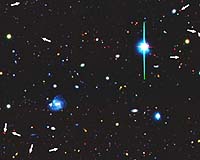
Nottingham, UK (SPX) Apr 09, 2008 Using the most sensitive images ever obtained with the United Kingdom Infra-Red Telescope (UKIRT), astronomers have found convincing evidence that galaxies which look old early in the history of the Universe reside in enormous clouds of invisible dark matter and will eventually evolve into the most massive galaxies that exist in the present day. University of Nottingham PhD student Will Hartley, who led the study, will speak at the RAS National Astronomy Meeting in Belfast on Tuesday 1 April. The distant galaxies identified in the UKIRT images are considered elderly because they are rich in old, red stars. However, because the light from these systems has taken up to 10 billion years to reach Earth, they are seen as they appeared in the very early Universe, just four billion years after the Big Bang. The presence of such fully evolved galaxies so early in the life of the cosmos is hard to explain and has been a major puzzle to astronomers studying how galaxies form and evolve. Hartley and collaborators used the deep UKIRT images to estimate the mass of the dark matter surrounding the old galaxies by measuring how strongly the galaxies cluster together. All galaxies are thought to form within massive halos of dark matter which collapse under their own gravity from a smooth distribution of matter after the Big Bang. These halos are invisible to normal telescopes but their mass can be estimated through analysis of galaxy clustering. Hartley explains "Luckily, even if we don't know what dark matter is, we can understand how gravity will affect it and make it clump together. We can see that the old, red galaxies clump together far more strongly than the young, blue galaxies, so we know that their invisible dark matter halos must be more massive." The halos surrounding the old galaxies in the early Universe are found to be extremely massive, containing material up to one hundred thousand billion times the mass of our Sun. In the nearby Universe, halos of this size are known to contain giant elliptical galaxies, the largest galaxies known. "This provides a direct link to the present day Universe," says Hartley, "and tell us that these distant old galaxies must evolve into the most massive but more familiar elliptical-shaped galaxies we see around us today. Understanding how these enormous elliptical galaxies formed is one of the biggest open questions in modern astronomy and this is an important step in comprehending their history." Community Email This Article Comment On This Article Related Links University of Nottingham Joint Astronomy Centre - UKIRT Stellar Chemistry, The Universe And All Within It
 Quasars Quash Star Formation In Active Galactic Nuclei
 London, UK (SPX) Apr 09, 2008
An ambitious study of active and inactive galaxies has given new insights into the complex interaction between super-massive black holes at the heart of Active Galactic Nuclei (AGN) and star formation in the surrounding galaxy. Results will be presented in a talk by Paul Westoby at the RAS National Astronomy Meeting in Belfast. |
|
|

| The content herein, unless otherwise known to be public domain, are Copyright 1995-2007 - SpaceDaily.AFP and UPI Wire Stories are copyright Agence France-Presse and United Press International. ESA Portal Reports are copyright European Space Agency. All NASA sourced material is public domain. Additional copyrights may apply in whole or part to other bona fide parties. Advertising does not imply endorsement,agreement or approval of any opinions, statements or information provided by SpaceDaily on any Web page published or hosted by SpaceDaily. Privacy Statement |