|
 |
 |
 |
 |
 |
 |
 |
 |

 |
Old Equation May Shed New Light on Planet Formation
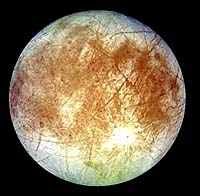
Tucson - Jan 12, 2004 New work with an old equation may help scientists calculate the thickness of ice covering the oceans on Jupiter's moon Europa and ultimately provide insight into planet formation. Planetary bodies, such as the Earth and its moon, exert such gravitational force on one another that tides occur, not just in the oceans, but also in bodies of the planets themselves. The surfaces of planets actually rise and fall slightly as they orbit one another. The standard for calculating how the gravity of one celestial body affects the shape of a second is an equation published in 1911 by A.E.H. Love. Sarah Frey, a doctoral candidate at the University of Arizona in Tucson, decided to see if she could figure out the thickness of ice on Europa by using Love's equation to calculate planetary tides. "Love looked at two cases, which were very well behaved, very similar to Earth's values," she said. However, Love didn't have the power of modern computers at his disposal. Working with Terry Hurford, a graduate student in UA's department of planetary sciences and Richard Greenberg, a professor of planetary sciences at UA, Frey used computers to calculate what Love's equations predicted for various spheres that differed from one another in density, compressibility and rigidity. The spheres serve as proxies for planets. To their surprise, the researchers found that in specific cases, the computer calculations suggested that the sphere would change shape dramatically. Frey said these special circumstances, called singularities, might ultimately reveal situations that would prevent the formation of planets. Greenberg said, "If a rocky planet was a little bit bigger than Earth or Venus, it would be in the danger zone where the formula would predict a substantial distortion in the planet's shape. We're wondering if in some way this regulated the size of the planets." Frey discussed the team's findings about Love's equations, "Characterization of instabilities in the tidal deformation of a planetary body," at the joint annual meeting of the American Mathematical Association and Mathematical Association of America (MAA) held last week. Community Email This Article Comment On This Article Related Links SpaceDaily Search SpaceDaily Subscribe To SpaceDaily Express Life Beyond Earth Lands Beyond Beyond - extra solar planets - news and science
 Latching Onto Lichen
 Moffett Field CA (SPX) Dec 06, 2005
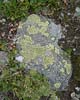
Bacteria can often survive the harsh conditions of space, and their toughness and adaptability have made them key candidates for the transfer of life between planets. But in a recent study by European scientists, lichen survived a trip in space even better than bacteria do. |
|
|

| The content herein, unless otherwise known to be public domain, are Copyright 1995-2006 - SpaceDaily.AFP and UPI Wire Stories are copyright Agence France-Presse and United Press International. ESA PortalReports are copyright European Space Agency. All NASA sourced material is public domain. Additionalcopyrights may apply in whole or part to other bona fide parties. Advertising does not imply endorsement,agreement or approval of any opinions, statements or information provided by SpaceDaily on any Web page published or hosted by SpaceDaily. Privacy Statement |