|
 |
 |
 |
 |
 |
 |
 |
 |

 |
"Official" Image Of Confucius Sparks Debate
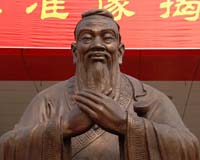
Jinan, China (XNA) Sep 26, 2006 A portrait of an ancient Chinese philosopher or a symbol of modern commercialism? The new "standardized" image of Confucius has sparked controversy among China's scholars, many of whom doubt it will stand the test of time. Designers have defended the image unveiled in a bronze statue on Saturday, saying it would better commemorate the ancient philosopher and promote his school of thought. However, critics call it commercialism and say there is no definite historical evidence that the statue commissioned by the China Confucius Foundation bears any resemblance to the great philosopher's actual appearance. Designers of the statue say this "doesn't really matter". "What matters is his founding of Confucianism, which features harmony and peace and constitutes the essence of Chinese culture," said Zhang Shuhua, secretary-general of the foundation. The government-backed organization, based in Jinan, east China's Shandong Province, was established in 1984 to raise funds for Confucian studies at home and abroad. By unveiling the "official" image, Zhang said his organization aims to give Confucius a single, recognizable identity to better promote Confucianism around the globe. "A Taiwanese society for Confucian studies launched a standard portrait of him in 1986." Zhang's foundation began to work on a standard portrait in January and released a draft in June. The final version was released last Saturday at Confucius' hometown Qufu in east China's Shandong Province to mark the 2,557th anniversary of his birth. The 225.7-cm bronze statue depicts Confucius as a kind old gentleman with a square face, long beard, broad mouth and thick brows. He wears a Chinese-style robe and his hands are crossed on his chest. "The version was agreed by renowned sinologists Ren Jiyu and Wen Huaisha as well as representatives of Confucius' descendants," said Zhang. The designers also referred to the most recognizable portrait of Confucius that dated to the Tang Dynasty, at least 1,100 years from today. Countless portraits of Confucius exist in China, representing different interpretations of the philosopher's features by artists throughout history. The earliest known version is a stone statue from the Western Han Dynasty (206 BC - 24 AD). Kong Xianglin, vice president of Confucius Research Institute, said it was important to give Confucius an "official" image so that people across the world had a uniform idea of the Chinese philosopher. "Otherwise, foreigners will never know which one actually portrays the great man." But Wang Dianqing, director of International Confucian Association, thinks otherwise. "It's really unnecessary to work out a new image of Confucius. It won't stand the test of history," he said.
earlier related report The CCF unveiled the final version of the portrait at a news conference in Qufu of east China's Shandong Province, hometown of Confucius, on the basis of a draft sculpture released in June this year. "Acting as a symbol of Chinese history and culture, Confucius is widely known around the world. A standard portrait is needed so that different countries could have the same image of him," said CCF general secretary Zhang Shuhua. The sculpture depicts Confucius as an old man with a long beard, broad mouth and big ears. He wears a robe and crosses his hands on his chest. The amended portrait highlights the ancient philosopher's kindness in appearance as well as his cultured and gentle characteristics, said professor Hu Xijia, a member of the sculpture design group. "We want to show a Confucius that exists in people's minds, who is a kind, sagacious and respectful person," said Hu, who started the work in January. The draft sculpture was based on the painting of Confucius by Wu Daozi of the Tang Dynasty (618 - 907), together with advice from Confucian scholars, historians, artists and his descendants. The new portrait would set the standard criteria for the image of Confucius, who had been represented in different ways when Chinese were presenting statues in foreign countries, said Zhang. Confucius was the founder of Confucianism, which advocates the building of a harmonious society through an individual's self-refinement in manners and taste. It was promulgated by Chinese rulers since the Western Han Dynasty (206 BC - 25 AD) and spread into east and south Asia. Confucianism dominated Chinese society for centuries, and spread to Europe in the late 16th century. Born in 551 B.C., Confucius, a great thinker, philosopher, statesman and educator, has more than 3 million descendants with Qufu as a concentration area, according to latest statistics. There are 2.5 million descendants of Confucius in the Chinese mainland, 100,000 in the Republic of Korea, and many in the United States, Malaysia and Singapore. Regarding Confucius as an outstanding educator, the United Nations Educational, Scientific and Cultural Organization (UNESCO)last year named an international prize after him -- Confucius Literacy Prize, to honor individuals and institutions which have made significant contributions to education. On Saturday, the UNESCO awarded the prize in Qufu, the first of its kind, to educational officials of India and Morocco to honor their decade-long efforts in eradicating illiteracy, especially among women and children, and helping drop-out children return school. In an effort to promote Chinese language and culture abroad, China has planned to set up 100 "Confucius Institutes" around the world to help foreigners learn Chinese. Scholars and believers around the world commemorate Confucius' birth at his hometown in Qufu every year to carry forward the Confucian spirit of benevolence and honor. Many scholars say that the research on the values of Confucianism are conducive to the building of a harmonious society in China and around the world.
Source: Xinhua News Agency Community Email This Article Comment On This Article Related Links China News From SinoDaily.com China News from SinoDaily.com
 US Reminds Taiwanese Leader Not To Break Commitments
 Washington (AFP) Sep 25, 2006
The United States on Monday reminded Taiwan's President Chen Shui-bian to keep his commitment not to raise sovereignty issues that could anger China, as the leader pushed for a new constitution for the island. Chen, under pressure to resign over corruption scandals, raised the issue of a new constitution at a seminar Sunday sponsored by his independence-leaning Democratic Progressive Party (DPP), a move likely to irk China which regards the island as its territory. |
|
|

| The content herein, unless otherwise known to be public domain, are Copyright 1995-2006 - SpaceDaily.AFP and UPI Wire Stories are copyright Agence France-Presse and United Press International. ESA PortalReports are copyright European Space Agency. All NASA sourced material is public domain. Additionalcopyrights may apply in whole or part to other bona fide parties. Advertising does not imply endorsement,agreement or approval of any opinions, statements or information provided by SpaceDaily on any Web page published or hosted by SpaceDaily. Privacy Statement |