|
 |
 |
 |
 |
 |
 |
 |
 |

 |
October Surprise: Red Star In Orbit
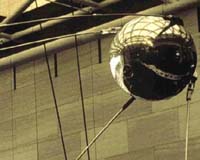
Washington (UPI) Oct 5, 2004 Big surprises do happen in October. And sometimes Americans and their leaders do not expect them. This week marks the 47th anniversary of the Start of the Space Age. And when it came, it took the American people and their leaders entirely by surprise Soviet Premier Nikita Khruschchev and his Chief Rocket Designer Sergei Korolev stunned Americans and impressed the world in the first week of October 1957, when an enormous R-7 booster blasted the world's first ever artificial satellite, Sputnik I, into orbit around the earth at a speed of 18,000 miles per hour. Korolev, the legendary chief designer of the Soviet space program, lofted Sputnik I into the heavens to beat out the more leisurely and problem-plagued U.S. Vanguard satellite program. He and his colleagues at what was then still the super-secret Baikonur cosmodrome in Kazakhstan, Central Asia rocked Americans' confident sense of their global technological superiority as nothing in the century since the Civil War ever had. But the shock proved to be a fruitful wakeup call. Three successive U.S. presidents - Dwight David Eisenhower, John F. Kennedy and Lyndon Baines Johnson - energized the U.S. space program with enthusiastic bipartisan support from Congress. For more than seven years, the United States seemed to trail behind as the Soviets under Korolev's inspired leadership chalked up a series of stunning achievements in space to follow sputnik: The first satellite was followed by the first animal, a dog, to orbit the earth. Then came the first human being to orbit the world, cosmonaut Yuri Gagarin in 1961. He was followed by the first day-long space mission of German Titov and Valentina Tereshkova, the first woman in space. Then Alexei Leonov became the first human being to walk in space. But the United States was catching up fast, and with the 1965-66 Gemini missions it surpassed the Soviets. After Korolev's tragically premature death in 1966, the Soviet space program languished while America's went from strength to strength. No Soviet cosmonaut ever flew above low earth orbit. At Christmas 1968, three U.S. astronauts went a quarter of a million miles further, orbiting the Moon on Apollo 8. Only seven months later, Neil Armstrong and Buzz Aldrin became the first human beings to walk on the surface of another world when they paced the lunar surface. Then their Apollo 11 spacecraft brought them safely home. The United States had exorcised the ghost of the October Surprise of Sputnik I in less than 12 years. The dazzling progress of the first 15 years of the Space Age - from 1957, when the Soviet Union launched Sputnik I, to the last Apollo moon landing - was followed by nearly three decades of energetic low orbit economic and scientific exploitation of space. But only a handful of unmanned space probes, all too many of them with shoddy equipment or programming flaws, have braved deeper space since. What went wrong? Ironically, famed comic book author Stan Lee probably got it right sooner than anyone else back in 1968, at the very brilliant height of the Space Race. It was the same year that the U.S. spacecraft Apollo 8 took the greatest single leap into the unknown in human history. It carried astronauts Frank Borman, James Lovell and Bill Anders a quarter of a million miles further than where any human had gone before to orbit the Moon and see its dark side for the first time with the naked eye. Yet Lee wrote about a mythical space-faring civilization in the first issue of his classic Silver Surfer comic. We had gone too far - seen too much. And then - we no longer cared. We of Zenn-La returned to our mother world - never to venture forth again! For us, the age of space travel had died - never to be born again. It was the prescient obituary for both the U.S. and Soviet space programs. Men like Werner Von Braun in the U.S. space program and Korolev in the Soviet one were replaced by the likes of Carl Sagan and popularizing physicist Freeman Dyson, who argued that unmanned Solar System probes were far more valuable scientifically and far cheaper than manned space exploration. Soviet and U.S. society were changing too. The Soviets remained far more committed to manned space flight than the Americans. But they were starved of resources to do anything with it. America's National Aeronautics and Space Administration, which had triumphantly achieved Kennedy's seemingly impossible lunar landing goal by 1969, decayed in the classic manner of government bureaucracies in the following decades and launched one unbelievably uneconomic and costly program after another. It also became dominated by a generation of scientist-bureaucrats - in Sagan's image - with an obsessive hatred of deeper space manned exploration. So maybe the crazed computer HAL in Stanley Kubrick's visionary movie 2001 had the last laugh after all. But around the world, an older generation still retains memories of the eerie thrill and wonder they felt as young children when they heard that magic beep-beep from Korolev's metal grapefruit broadcasting its short wave radio signals to an amazed human race. A new frontier, far vaster than anything Christopher Columbus and America's Western pioneers had ever dreamed of, was suddenly within our grasp. That October Surprise in the long run sowed new seeds of vision and hope for the entire human race, as well as inspiring a generation of Americans to some of their finest achievements. And perhaps, one day in the future, the dreams kindled then will finally be realized. All rights reserved. Copyright 2004 by United Press International. Sections of the information displayed on this page (dispatches, photographs, logos) are protected by intellectual property rights owned by United Press International. As a consequence, you may not copy, reproduce, modify, transmit, publish, display or in any way commercially exploit any of the content of this section without the prior written consent of by United Press International. Community Email This Article Comment On This Article Related Links SpaceDaily Search SpaceDaily Subscribe To SpaceDaily Express Space Analysis and Space OpEds
 Why That Foam Keeps Falling
 Honolulu HI (SPX) Aug 07, 2005
Since the foam-loss fiasco on STS-114, I have read a lot of theorizing about why the foam continues to fall off the Shuttle External Tank in such dangerously large chunks, despite the estimated $200M spent by NASA to solve this problem. |
|
|

| The content herein, unless otherwise known to be public domain, are Copyright 1995-2006 - SpaceDaily.AFP and UPI Wire Stories are copyright Agence France-Presse and United Press International. ESA PortalReports are copyright European Space Agency. All NASA sourced material is public domain. Additionalcopyrights may apply in whole or part to other bona fide parties. Advertising does not imply endorsement,agreement or approval of any opinions, statements or information provided by SpaceDaily on any Web page published or hosted by SpaceDaily. Privacy Statement |