|
 |
 |
 |
 |
 |
 |
 |
 |

 |
Ocean Spray Lubricates Hurricane Winds
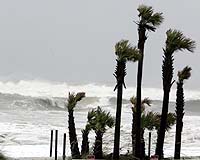
Berkeley CA (SPX) Jul 26, 2005 Hurricane Emily's 140-mile-per-hour winds, which last week blew roofs off hotels and flattened trees throughout the Caribbean, owed their force to an unlikely culprit � ocean spray. According to a new study by two University of California, Berkeley, mathematicians and their Russian colleague, the water droplets kicked up by rough seas serve to lubricate the swirling winds of hurricanes and cyclones, letting them build to speeds approaching 200 miles per hour. Without the lubricating effect of the spray, the mathematicians estimate, winds would rise to little more than 25 miles per hour. "This is not a small effect," said Alexandre Chorin, professor of mathematics at UC Berkeley and faculty researcher at Lawrence Berkeley National Laboratory (LBNL). He and fellow UC Berkeley mathematics professor Grigory I. Barenblatt, also of LBNL, along with V. M. Prostokishin of the Shirshov Institute of Oceanology in Moscow, published their analysis of the effect of ocean spray in the Early Online Edition of the Proceedings of the National Academy of Sciences. Over the past decade, the three mathematicians have developed a body of equations to describe turbulence in fluids and have applied these equations to many practical problems. Turbulence slows flowing liquids or gases by generating eddies, swirls and vortices, and thus plays a role in keeping airplanes aloft, slowing ships and taming rivers. "Turbulence is generally a good thing," Chorin said, noting that without turbulence the Mississippi River at its mouth would be flowing at supersonic speed. "You need turbulence to make friction stronger." The equations, when applied to a cloud of water droplets sandwiched between flowing air and water, indicate that large water droplets thrown up by cresting waves in rough seas inhibit the turbulence in the air over the ocean. Without this turbulence to drain energy from the swirling winds, winds can build to tremendous speeds. Without turbulence, friction between the air and water would be reduced by a factor of 1,000, Chorin said, sometimes allowing winds to rise to speeds eight times greater than would be the case with turbulence. The turbulent vortices in the air are suppressed by the droplets when they rain back into the sea, somewhat like "combing unruly hair," Chorin said. These droplets are about 20 microns across (8 ten-thousandths of an inch) or larger. The smaller the droplets, the less ability they have to suppress the turbulence, he said, which suggests one way to calm hurricanes. "If you could develop a detergent to reduce the size of the droplets, you might be able to stop a hurricane," he said. "That's not as far fetched as it sounds. In ancient times, sailors carried oil to pour out on the water to calm storms. Pouring oil on choppy waters was not a superstition." In their paper, the mathematicians conclude that "We think that the action of oil was exactly the prevention of the formation of droplets! The turbulence was restored after the oil was dropped, the turbulent drag increased, and the intensity of the squall was reduced. Possibly hurricanes can be similarly prevented or damped by having airplanes deliver fast decaying harmless surfactants to the right places on the sea surface." The team began working on the problem after a colleague, Sir M. James Lighthill, suggested to Barenblatt at a party that drops in ocean spray might have a lubricating effect on hurricane winds. Hurricanes or, more properly, tropical cyclones, form at low-pressure areas over warm, tropical oceans. Swirling air is accelerated by energy from the warm water. Lighthill was unable to solve the problem before his untimely swimming death in 1998, but his friends took on the task employing their turbulence models. The paper is dedicated to "the great mathematician and fluid mechanician Sir James Lighthill." Whereas Lighthill thought that evaporation of the droplets cooled the atmosphere and led to accelerated winds, Chorin, Barenblatt and Prostokishin have showed that more important is the reduction of turbulence by falling droplets. Nevertheless, they note that evaporative cooling also serves to reduce turbulence and thus allow winds to build. Community Email This Article Comment On This Article Related Links University of California - Berkeley SpaceDaily Search SpaceDaily Subscribe To SpaceDaily Express Bringing Order To A World Of Disasters When the Earth Quakes A world of storm and tempest
 New Orleans Colleges To Reopen This Week
 New Orleans, Louisiana (AFP) Jan 05, 2006
Thousands of students and faculty are returning to New Orleans' eight colleges and universities this week for the first time since hurricane Katrina flooded the city four months ago. |
|
|

| The content herein, unless otherwise known to be public domain, are Copyright 1995-2006 - SpaceDaily.AFP and UPI Wire Stories are copyright Agence France-Presse and United Press International. ESA PortalReports are copyright European Space Agency. All NASA sourced material is public domain. Additionalcopyrights may apply in whole or part to other bona fide parties. Advertising does not imply endorsement,agreement or approval of any opinions, statements or information provided by SpaceDaily on any Web page published or hosted by SpaceDaily. Privacy Statement |